
Himlung Himal Expedition - 7126 M - 30 Days
30 Days
Kathmandu
Kathmandu
7126 m
Autumn
Hotel, Tea house & Camping
Road Transportation
15
7000er
Annapurna
A high-altitude 7,000-meter expedition in the remote Nar Phu Valley of the Peri Himal, Nepal. Located within the Annapurna Conservation Area on the Nepal-Tibet border, Himlung Himal is one of the most accessible and rewarding peaks above 7,000 meters, offering a genuine expedition experience with moderate technical demands and one of the highest summit success rates among 7,000-meter peaks in the Himalaya.
Introduction
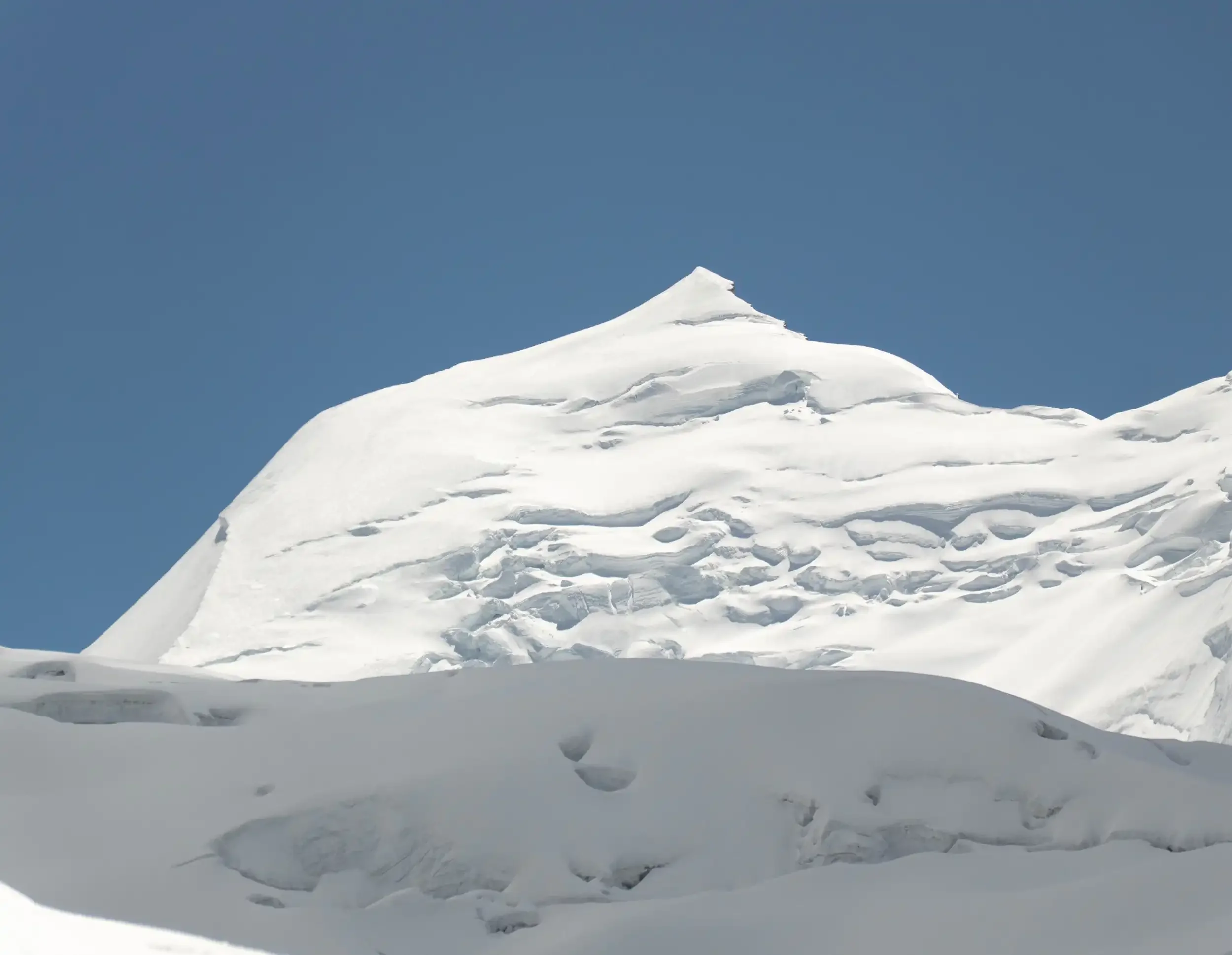
Himlung Himal stands at 7,126 meters (23,379 ft) in the Peri Himal sub-range of the Manang District, within Nepal's Gandaki Province. The mountain lies approximately 25 kilometers northwest of Manaslu (8,163 m) and sits along the Nepal-Tibet border, within the Annapurna Conservation Area (ACAP). Its summit is the highest point in this section of the Peri Himal and offers an unobstructed view north across the Tibetan Plateau.
The first confirmed ascent of Himlung Himal was made on October 3, 1992, by a Japanese expedition team led by Akio Koizumi, climbing via the northwest ridge. The Nar Phu Valley had been closed to foreign visitors for many years prior and officially opened to expeditions in 1992, making that first ascent a significant milestone. Since then, Himlung has gained recognition across the international mountaineering community as a reliable high-altitude objective, particularly for climbers preparing to step into the 8,000-meter range.
The approach to Himlung Himal follows the lower section of the Annapurna Circuit as far as Koto (2,610 m), before branching into the restricted Nar Phu Valley. This is one of Nepal's least visited areas. The valley's culture is distinctly Tibetan in character, shaped by centuries of salt trade across the high passes into Tibet. Villages such as Meta, Kyang, and Phu (Phu Gaon) retain ancient stone gompas, mani walls, and chortens that reflect the Bon and Tibetan Buddhist traditions of the region. The trek through Nar Phu provides genuine cultural depth that is difficult to find on the busier trekking corridors of the Khumbu or lower Annapurna.
Technically, Himlung Himal involves glacier travel, snow slopes, crevasse navigation, and fixed-rope sections on the steeper terrain above Camp II. The mountain does not demand the extreme technical skills required on higher or more complex peaks, but it should not be underestimated. Altitude, objective hazard, and the remoteness of the location all require sound preparation, proper acclimatization, and experienced support.
Our Himlung Himal Expedition is fully supported with experienced high-altitude climbing Sherpas, complete base camp facilities, and a structured acclimatization rotation schedule designed to prepare climbers safely for the summit push. All permits and logistics are arranged by Expedition Himalaya prior to departure.
Himlung Himal is well suited for climbers with previous experience on peaks in the 5,500-to-6,500-meter range, comfortable with crampons, ice axe, and fixed-line technique, and looking to move into the 7,000-meter category. It serves as a logical and manageable progression before tackling the 8,000-meter peaks such as Manaslu, Cho Oyu, or Everest.
Himlung Himal Climbing Route & High Camps
The standard climbing route on Himlung Himal follows the northeast face from a base camp established above Phu Gaon. Our expedition follows a two-camp strategy above Base Camp, with the summit push made directly from Camp II. A third camp higher on the mountain remains an option and is established only if snow conditions, climbing pace, or weather make it necessary. This approach keeps the team efficient, limits unnecessary exposure at altitude, and reflects how conditions on Himlung Himal typically allow for a direct summit rotation from Camp II when the acclimatization process has been carried out properly.
The terrain involves a combination of moraine, glacier, and snow and ice slopes. Gradient on the lower mountain is generally between 25 and 30 degrees, steepening to 35 degrees and above on the approach to the upper ridge. Objective hazards are relatively low compared to more complex Himalayan routes, with manageable crevasse terrain on the lower glacier and limited serac exposure throughout.
Himlung Himal Base Camp (4,850 m / 15,912 ft)
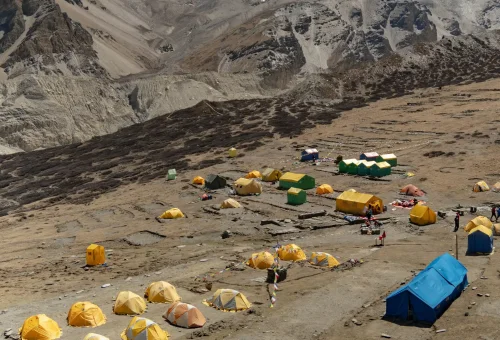
Base Camp is established on a moraine shelf above Phu Gaon at approximately 4,850 meters (15,912 ft). It offers clear sightlines to the upper mountain and views of neighbouring Peri Himal peaks including Kang Guru (6,981 m), Gyaji Khang (7,038 m), and Ratna Chuli (7,035 m). Base Camp is the main operational hub for the expedition. Kitchen and dining tents, individual sleeping tents, communication equipment, and medical supplies are all based here. The team returns to Base Camp between acclimatization rotations to rest and recover before the next push. A puja ceremony is performed at Base Camp before climbing begins, in keeping with Himalayan mountaineering tradition.
Himlung Himal Camp I (5,450 m / 17,881 ft)
Camp I is reached from Base Camp in approximately 4 to 6 hours, following a route across rocky moraine before gaining the lower glacier. The terrain on this section is non-technical but demands steady stamina. Crevasses are present on the lower glacier and route-finding requires care, particularly in flat light or poor visibility.
Camp I is situated at 5,450 meters (17,881 ft) on a stable section and serves as the first acclimatization camp above Base Camp. During the rotation phase, climbers ascend to Camp I, sleep one or two nights to gain altitude exposure, and then descend to Base Camp to rest and consolidate the adaptation before the next rotation to Camp II.
Himlung Himal Camp II / High Camp (6,200 m / 20,341 ft)
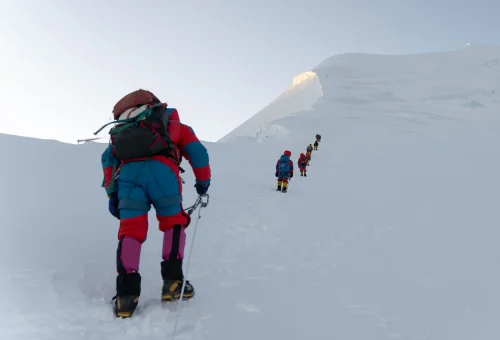
Above Camp I, the route steepens as it gains the upper glacier. The approach to Camp II involves snow-covered slopes and sections of wind-hardened ice, with fixed ropes in place on the steeper pitches. This is the most demanding section of the climbing route in terms of sustained effort, requiring strong crampon technique and controlled movement on fixed lines at increasing altitude.
Camp II is established at 6,200 meters (20,341 ft) on a broad snow plateau with clear views of the upper mountain and the Tibetan Plateau to the north. This is the High Camp for our expedition and the point from where we start the summit push. Climbers arrive at Camp II in the early afternoon, rest, eat, and prepare equipment before attempting to sleep ahead of a pre-dawn departure for the summit.
Summit Push from Camp II | Himlung Himal (7,126 m / 23,379 ft)
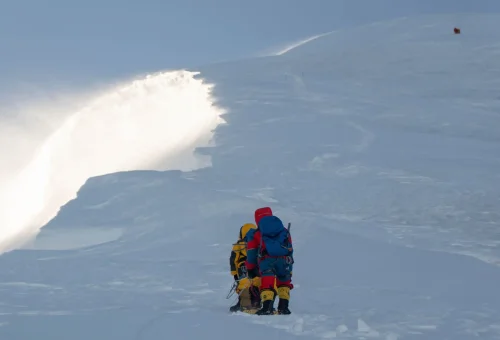
From Camp II, the route climbs steadily toward the upper ridge of the northeast face. The initial section above camp crosses a heavily crevassed zone that requires careful navigation and is one of the more technically demanding passages on the mountain. Fixed ropes are in place through this section. Once past the crevasse band, the slope steepens to 30 to 35 degrees on the approach to the upper ridge. This is a sustained push of approximately 400 meters of elevation gain on compacted snow and ice, and it is the longest and most physically demanding portion of the summit day. Fixed lines cover the steeper pitches.
Above the steep section, the gradient eases as the route reaches the broader summit ridge. The final approach to the summit follows this ridge at an angle that, while less steep, is at full altitude and demands disciplined pacing and consistent movement. The summit of Himlung Himal at 7,126 meters provides an open panorama across a wide arc of the central Himalaya.
From the summit, the view extends to Manaslu (8,163 m) and the full Annapurna massif, including Annapurna II (7,937 m), Gangapurna (7,455 m), and Annapurna South (7,219 m). Neighboring Peri Himal peaks including Gyaji Khang (7,038 m) and Ratna Chuli (7,035 m) are visible at close range, and the Tibetan Plateau stretches uninterrupted to the north.
After the summit, the team begins the descent immediately, returning by the same route. The team moves carefully back through the fixed-rope sections and crevasse zone. Climbers return to Camp II to rest briefly before continuing down to Camp I and Base Camp. The full summit day, from Camp II departure to return to Camp II, typically takes between 10 and 14 hours depending on conditions and team pace.
Why Himlung Himal?
Himlung Himal has established itself as one of the more sought-after 7,000-meter objectives in Nepal for a number of reasons grounded in the mountain's character, location, and climbing record.
- At 7,126 meters, the mountain sits firmly in the high-altitude mountaineering category with all the physiological demands that come with extended time above 6,000 meters. The standard route does not require the extreme technical skills needed on more demanding objectives, making it a realistic and well-matched progression for climbers with solid 6,000-meter experience and sound crampon and fixed-line technique.
- Himlung Himal is widely recognized as an effective preparation peak for the 8,000-meter range. The two-camp structure, extended time at altitude, and the demands of glacier travel, crevasse navigation, and fixed-line climbing above 6,000 meters give climbers the systems, rhythm, and physiological adaptation needed before attempting peaks such as Manaslu, Cho Oyu, or Everest.
- Himlung has one of the highest recorded summit success rates among Nepal's 7,000-meter peaks, according to the Himalayan Database. This reflects the mountain's favorable route characteristics, relatively low objective hazard, and the manageable two-camp structure that keeps climbers efficient and limits unnecessary time at altitude.
- The Nar Phu Valley approach adds a dimension to this expedition that most high-altitude climbs do not offer. The valley is a restricted area that sees very few visitors. The cultural environment, shaped by Tibetan Buddhism and centuries of salt trade across the high passes, is authentic and has not been significantly altered by the trekking industry. The journey to Base Camp is a meaningful part of the expedition in its own right.
Itinerary
Day 1: Arrive Kathmandu (1,330 m / 4,364 ft)
Upon arrival at Tribhuvan International Airport, you are welcomed by the Expedition Himalaya team and transferred to your hotel. The day is kept light to allow recovery from international travel. You may rest or take a short walk to get familiar with the city atmosphere.
Day 2: Documentation & Preparation
This day is dedicated to expedition preparation. Necessary permits and documentation are finalized, and a full equipment check is carried out with the expedition leader. You may also visit selected cultural sites in the Kathmandu Valley, gaining insight into Nepal’s history, religion, and architecture.
Day 3: Drive to Besisahar (800 m / 2,664 ft)
A scenic drive takes you west from Kathmandu to Besisahar, passing rivers, terraced farmland, and traditional villages. This journey marks the transition from urban landscapes to the Himalayan foothills and the start of the approach toward the Nar–Phu region.
Day 4: Drive to Koto (2,675 m / 8,774 ft)
The drive continues along the Marsyangdi Valley, following mountain roads through narrow gorges, waterfalls, and increasingly remote terrain. As altitude increases, the scenery becomes more dramatic, signaling entry into the higher Himalayan environment.
Day 5: Trek to Meta (3,560 m / 11,678 ft)
Today’s trek officially enters the restricted Nar–Phu Valley. The trail climbs steadily through forests and rocky sections, crossing rivers and passing abandoned settlements. The landscape begins to open into wide alpine valleys as you reach Meta, a seasonal grazing area surrounded by high ridges.
Day 6: Trek to Chyakhu (3,840 m / 12,598 ft)
The trek continues through an increasingly dry and rugged trans-Himalayan landscape. Yak pastures, stone shelters, and expansive views dominate the route. The gradual ascent supports continued acclimatization as the trail leads deeper into the remote Nar–Phu region.
Day 7: Trek to Phu Village (4,050 m / 13,284 ft)
A scenic trek brings you to Phu Village, one of Nepal’s most isolated and culturally preserved settlements. Traditional stone houses, ancient monasteries, and prayer walls reflect strong Tibetan influence. The surrounding peaks and high plateau setting provide a striking Himalayan backdrop.
Day 8: Acclimatization & Exploration at Phu (4,050 m / 13,284 ft)
This planned acclimatization day allows your body to adapt to altitude. Short hikes around the village offer views of nearby glaciers and peaks while providing valuable elevation gain. Time is also spent resting and preparing for the approach to base camp.
Day 9: Trek to Himlung Base Camp (4,850 m / 15,912 ft)
The trek ascends above Phu Village, crossing alpine terrain and glacial moraines. As you approach base camp, Peri-Damodar mountain range dominates the skyline. Base Camp is established on a broad, open site beneath the mountain’s north face, offering a clear view of the climbing route.
Day 10: Acclimatization, Preparation & Rest at Base Camp (4,850 m / 15,912 ft)
This day is used for rest and final preparation before the climbing phase. The expedition leader outlines the rotation plan, safety procedures, and weather strategy. Equipment is sorted, packed, and checked thoroughly in preparation for movement to higher camps.
11 - 23: Climbing Period - Summit (7,126 m / 23,379 ft)
This period forms the core phase of the Himlung Himal Expedition, focused on acclimatization, load carries, camp establishment, and summit attempts. Climbers move progressively between Base Camp and higher camps, allowing the body to adapt safely to altitude while becoming familiar with the route and terrain.
The standard route involves snow and glacier travel, with 1/2 structured acclimatization rotations completed before the summit push. During these rotations, climbers carry loads to higher camps and return to lower elevations for recovery, building strength, confidence, and acclimatize.
Ropes are fixed on steeper and exposed sections to improve safety and efficiency. Camp placements and movement schedules are determined by snow conditions and weather patterns. The summit attempt is planned only when conditions and individual health align, with all decisions made conservatively and with safety as the top priority.
Day 24: Success Celebration, Base Camp Clean-Up & Rest
After completing the climbing phase, the team rests at base camp. Equipment is packed and the site is cleaned in line with responsible expedition practices. This day allows time for recovery and reflection on the expedition.
Day 25: Trek to Meta (3,560 m / 11,678 ft)
The descent begins as you retrace the route through high valleys and alpine terrain. With decreasing altitude, the trek becomes more comfortable while still offering expansive mountain views.
Day 26: Trek to Koto (2,675 m / 8,774 ft)
The trail continues downward through forests and river valleys, returning to greener landscapes and lower elevations of the Marsyangdi region.
Day 27: Drive to Kathmandu (1,330 m / 4,364 ft)
A scenic drive takes you to Kathmandu. The change in environment offers a relaxed transition after weeks in remote mountain terrain. Your hotel accommodation will be ready and waiting for you to return so that you can unwind in it.
28 - 29: Rest and Leisure Day in Kathmandu
These days are reserved for rest and recovery after the expedition. Time is available for personal activities, souvenir shopping, optional sightseeing in the Kathmandu Valley, or simply relaxing and reflecting on the journey before international departure.
Day 30: International Departure
On the final day, you will be assisted with your departure arrangements. The team will transfer you to Tribhuvan International Airport for your flight back home, taking with you memories of an unforgettable mountaineering adventure.
Includes
- SERVICE IN KATHMANDU
- Airport Pick-up and Drop-off service in a private tourist vehicle.
- 4 night’s accommodation in Kathmandu in Hotel Manaslu or Hotel Tibet including Bed and Breakfast on twin sharing basis
- Welcome dinner at an authentic Nepali restaurant in Kathmandu
- Road transfers as per itinerary
- GOVERNMENT AND RELATED CHARGES
- Himlung Climbing Permit, Nar-Phu Restricted Area Permit and all required permits and costs related to Permit
- Liaison Officer for Expedition Team including insurance, wages, gears and all other costs
- Garbage Deposit Fees & Rope Fixing Charge
- Summit Certificate from Department of Tourism, MoCTCA
- SERVICE IN TREK
- Accommodation during the trek in standard Teahouses in Full Board Meal Plan
- Services of an experienced English-speaking trekking guide during the trek and their entire expenses.
- Porters (One porter for every 1 members) and their entire expenses
- First Aid Kit (Carried by trek guide)
- BASE CAMP SERVICE
- Base Camp Accommodation with an individual sleeping tent with mattress.
- Base Camp service (shared with the group) includes a kitchen tent with the cook, kitchen boy, dining tent with tables and chairs, shower tent, toilet tent, storage tent, gas heater,etc.
- EPI gas and High altitude foods during the climb having high calories.
- First aid kit at the Base Camp
- EXPEDITION SERVICE
- One climbing Sherpa for one climbing member during the climb.
- Sherpa's remuneration and load-bearing bonus (this bonus does not include the summit bonus)
- Climbing equipment, transportation, lodging, food, and salaries for Sherpas and staff are provided.
- The expenses of Insurance for Sherpa, trekking guide and porters and salary for all staffs. (includes Heli evacuation for Sherpa)
- Walkie-Talkie and Satellite Phone (Charges Per Call).
- Rope fixing charge and Applicable local and government taxes.
Excludes
- International airfare to and from Kathmandu and Nepal Visa Fees.
- Travel & medical insurance including insurance for emergency rescue & evacuation.
- Lunches and dinners in Kathmandu except Welcome dinner.
- Personal expenses such as telephone, laundry, bottled water, bar bills, trekking/climbing gears, etc.
- Tips for Sherpa & tips for local staffs.
- Summit bonus for climbing Sherpa ($ 1000)
- Any extra cost arising out of natural calamities or cancellation of the program.
- All other items not mentioned in the list of ‘Inclusions’.
Booking
Reviews

Good!
Exellent guide for solo trekking. The flexibility of the programm was good and everything worked with Expedition Himalaya.

Frequently Asked Questions
Why is Himlung Himal considered an ideal first 7,000 m expedition?
Himlung Himal is widely regarded as one of the best progression peaks for climbers stepping into the 7,000 m category. The mountain offers a genuine expedition experience remote access, multiple high camps, glacier travel, and sustained altitude without the extreme technical difficulty of higher 7,000 m or 8,000 m peaks. It allows climbers to test acclimatization strategies, decision-making, and endurance in a controlled yet serious high-altitude environment.
What prior experience should I have before joining the Himlung Expedition?
Ideally, climbers should have successfully completed at least one peak above 6,000 m (such as Mera Peak, Island Peak, or Lobuche East) and have trekked above 5,000 m multiple times. Experience using crampons, ice axe, fixed ropes, and operating in cold, glaciated terrain is strongly recommended. Himlung is not a beginner’s mountain—it is designed for climbers preparing for long-term progression.
Is Himlung suitable if my long-term goal is an 8,000 m peak?
Yes. Himlung is often used as a preparatory expedition for future objectives such as Manaslu, Cho Oyu, or even Everest. The altitude, expedition duration, and camp structure closely mirror 8,000 m expeditions, helping climbers understand how their body responds above 6,500 m, how they manage recovery days, and how they perform during summit pushes.
How technical is the climb?
Himlung is primarily a snow and ice climb with moderate technical difficulty. The route involves glacier travel, crevasse navigation, fixed ropes, and steep snow sections, particularly above Camp II. While it does not require advanced technical climbing, it demands solid basic mountaineering skills, efficient movement at altitude, and disciplined rope management.
How does Expedition Himalaya handle acclimatization on Himlung?
Our acclimatization plan is conservative and proven. The expedition follows a gradual ascent profile with planned rotation climbs to higher camps and adequate rest days. We emphasize “climb high, sleep low” principles, continuous health monitoring, and flexibility based on individual acclimatization responses rather than rigid schedules.
What kind of Sherpa support is provided?
Expedition Himalaya provides strong, experienced high-altitude Sherpa support with extensive experience on 7,000 m and 8,000 m peaks. Sherpa climbers assist with route fixing, camp setup, load carries, and summit support. Our approach prioritizes teamwork, mutual respect, and shared safety responsibility between climbers and Sherpa staff.
What safety and medical protocols are in place?
Safety is central to Expedition Himalaya’s operations. The expedition is equipped with high-altitude medical kits, oxygen for emergency use, and clear evacuation protocols. Expedition leaders are trained in high-altitude risk management, and daily health checks are conducted during rotations and at higher camps.
How physically demanding is the expedition?
Himlung requires strong cardiovascular endurance, leg strength, and mental resilience. Climbers should be comfortable carrying personal loads at altitude, climbing for 6–10 hours on summit day, and operating in cold, windy conditions. A structured pre-expedition training plan is strongly advised.
How does Himlung help in building a mountaineering career?
For aspiring professional climbers, guides, or expedition staff, Himlung provides invaluable experience in expedition logistics, high-camp operations, teamwork, and leadership under stress. Many climbers use Himlung as a credential-building peak before pursuing advanced certifications or larger expedition roles.
What mindset should I bring to a 7,000 m expedition?
A successful Himlung expedition requires humility, patience, and respect for the mountain. Summit success is important, but sound judgment, safety, and long-term health matter more. Climbers who approach Himlung with a learning mindset often gain the most—both technically and personally.
How does Expedition Himalaya differ from other operators on Himlung?
Expedition Himalaya focuses on realistic itineraries, experienced leadership, and ethical expedition practices. We do not rush acclimatization, overpromise summit success, or compromise safety for schedules. Our goal is to help climbers progress responsibly toward higher objectives, season after season.
Required Climbing Gear – Himlung Himal Expedition (7,126 M)
Climbing Himlung Himal requires full 7000 / 8000 meter high altitude equipment. The mountain is technically moderate, but temperatures can drop to –35°C and wind exposure is significant above Camp II. Proper gear is critical for safety and summit success.