
Ama Dablam Expedition - 30 Days
30 Days
Kathmandu
Kathmandu
6812 m
Spring and Autumn
Tea house & Camping
Domestic Flights and Road Transfers
15 Pax
Heli Flight
Technical 6000er
Climb Ama Dablam (6,812m / 22,349 ft), one of the most recognizable and technically engaging peaks in the Himalaya, via the classic Southwest Ridge, with a comfortable Base Camp stay and full expedition support from Kathmandu to summit.
Introduction
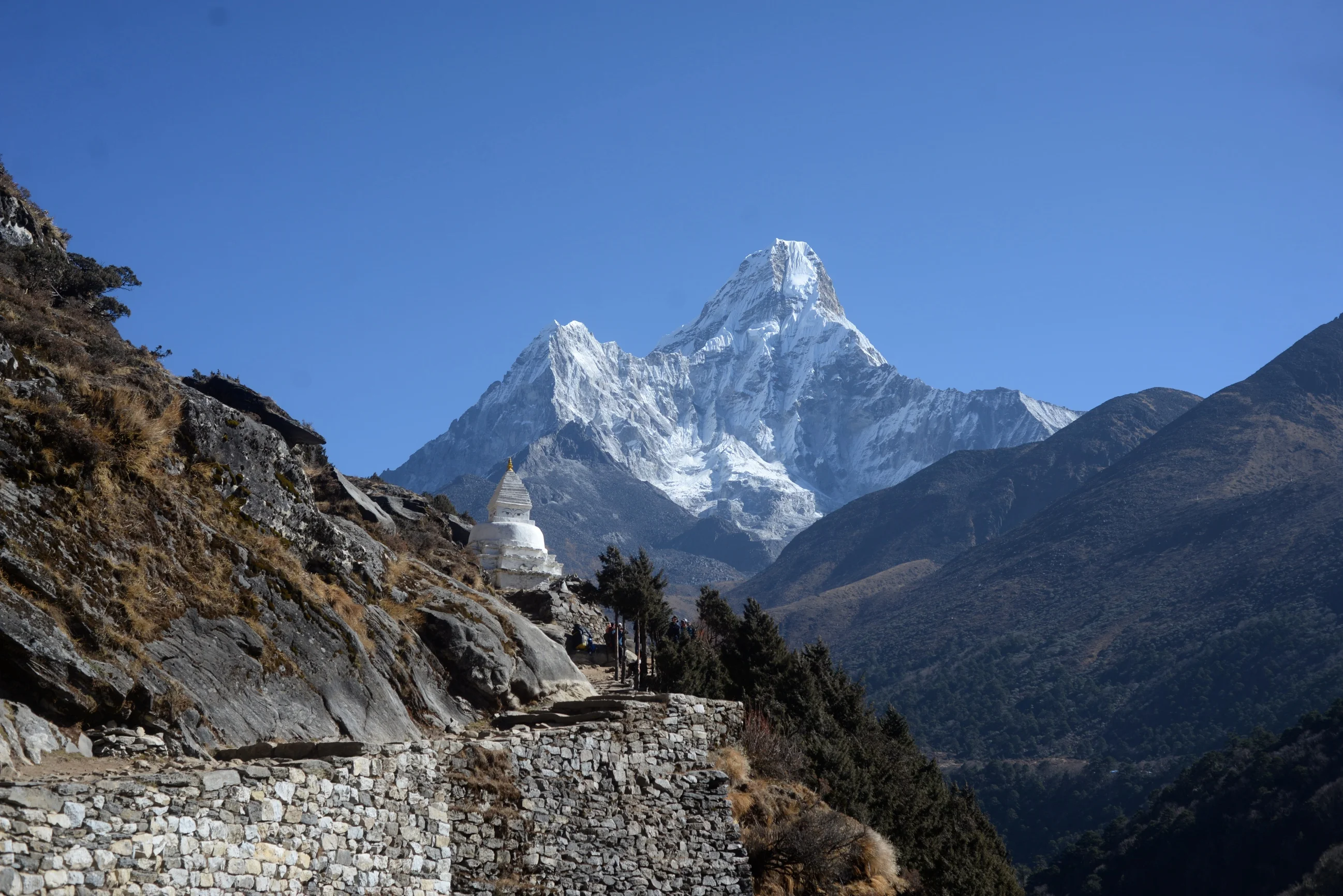
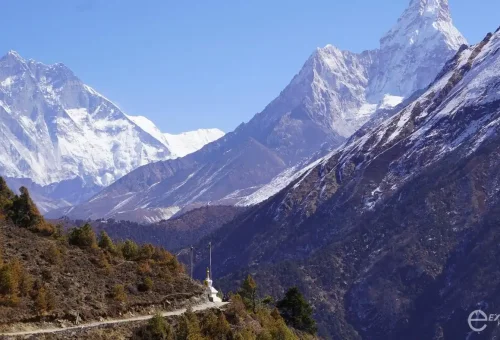
Mount Ama Dablam, “Mother's Necklace” in the Sherpa language, stands at 6,812m / 22,349 ft in the Khumbu region of northeastern Nepal, with Everest and Lhotse visible from its upper slopes. Its distinctive shape, a sharp main ridge flanked by hanging glaciers that resemble a necklace's pendant, makes it one of the most photographed peaks in the world and one of the most sought-after technical objectives for climbers who have already built a foundation of rock and ice experience.
The mountain was first climbed on March 13, 1961, by Mike Gill, Barry Bishop, Mike Ward, and Wally Romanes via the Southwest Ridge, the route that remains the standard commercial line today. A rare and historically notable winter ascent followed on December 5, 1983, by three South Korean climbers, Nam Sun-Woo, Lim Byung-Kil, and Kim Young-Soo, a genuine achievement given how harsh winter conditions are on this route, though winter climbing is not commercially offered today and this is a piece of mountaineering history rather than a current option.
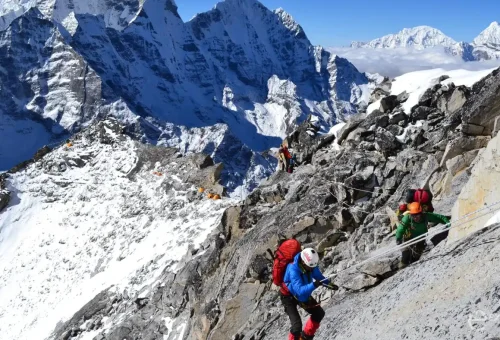
The approach follows the classic lower Khumbu trail through Namche Bazaar, Tengboche, Debuche, and Pangboche before turning off toward Base Camp at 4,600m / 15,092 ft, where climbers settle in for a comfortable Base Camp stay ahead of the climbing period. Above Base Camp, the climb becomes a serious technical undertaking: Camp 1 on the ridge, Camp 2 below the fixed-rope Yellow Tower, and Camp 3 near the exposed Mushroom Ridge and Grey Tower, all connected by sustained rock and ice climbing rather than straightforward trekking terrain.
Ama Dablam is graded Technical Climbing and is significantly harder than trekking peaks like Mera, Yala, or even Island Peak. It is not a first Himalayan objective. Successful climbers typically arrive with prior rock and ice climbing experience, real comfort operating on fixed ropes at altitude, and often a trekking-peak summit already completed. Expedition Himalaya runs this expedition primarily in autumn (mid-September to November), the season nearly every established operator schedules around, with a smaller spring window (March to May) also available, full permit handling, an experienced climbing Sherpa team, and an extended climbing period built specifically to work around weather and the shared fixed-rope schedule used by every team on the mountain that season.
Ama Dablam Expedition - Trip Highlights
- Climb Ama Dablam (6,812m / 22,349 ft), one of the most recognizable and technically engaging 6,000m peaks in the world, via the classic Southwest Ridge
- A comfortable Base Camp stay ahead of and between climbing rotations, rather than a bare-bones tented setup
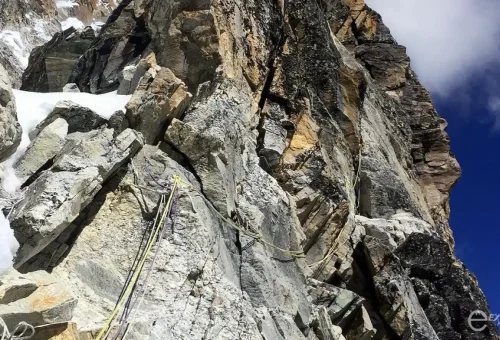
- Tackle genuine technical terrain: the fixed-rope Yellow Tower, the exposed Mushroom Ridge and Grey Tower, and a final snow and ice climb below the summit's hanging glacier
- Full expedition support with one climbing Sherpa per member and an extended climbing period built around weather and rope-fixing schedules
Itinerary
Day 1: Arrive Kathmandu (1,330 m / 4,364 ft)
A representative from Expedition Himalaya meets you at Tribhuvan International Airport and transfers you to your hotel. The rest of the day is free to rest after international travel, and in the evening a brief welcome briefing introduces the expedition plan.
Day 2: Rest, permit processing, and expedition briefing in Kathmandu (1,330 m / 4,364 ft)
Your Ama Dablam climbing royalty, Sagarmatha National Park permit, Khumbu Pasang Lhamu Rural Municipality permit, and rope-fixing contribution are all processed today. Personal and rented climbing gear is checked item by item against the packing list. The day is also free to explore Kathmandu's UNESCO sites, including Boudhanath Stupa and Swayambhunath Temple, before a detailed evening briefing covering the full route and the climbing plan ahead.
Day 3: Fly to Lukla (2,860 m / 9,383 ft), trek to Phakding (2,610 m / 8,563 ft)
The short, dramatic flight to Lukla is followed by an easy first trekking day, following the Dudh Koshi River downstream through pine forest and small villages to Phakding, a gentle introduction before the trail climbs in earnest.
Day 4: Trek to Namche Bazaar (3,440 m / 11,286 ft)
The trail follows the river valley, crossing several suspension bridges, before a long, steady climb into Namche Bazaar, the trading and cultural hub of the Khumbu and the last town with real shops and services before the trail turns properly alpine.
Day 5: Rest and acclimatization day in Namche Bazaar (3,440 m / 11,286 ft)
A short hike to a nearby viewpoint gives the first real payoff views of Everest and Ama Dablam on a clear day, while the climb-high-sleep-low pattern supports acclimatization. The rest of the day is free to explore Namche's museums and shops.
Day 6: Trek to Debuche (3,820 m / 12,533 ft)
The trail continues through rhododendron forest and along the river, passing Tengboche and its monastery, the most important in the region, before a short further walk to Debuche.
Day 7: Trek to Pangboche (3,985 m / 13,074 ft)
A relatively short day to Pangboche, a traditional Sherpa village that gives the first genuinely close views of Ama Dablam's full profile, ridge, hanging glaciers, and summit dome all clearly visible ahead.
Day 8: Trek to Ama Dablam Base Camp (4,600 m / 15,092 ft)
The trail leaves the main Khumbu route and climbs steadily toward Base Camp, with gradually thinning vegetation and closer views of the mountain's Southwest Ridge for most of the walk. On arrival, the group settles into a comfortable Base Camp stay, with proper meals, a dedicated rest and dining area, and considerably better recovery conditions than a bare tented camp. Climbing gear is organized and sorted the same afternoon in preparation for the climbing period ahead.
9 - 24: Climbing Period (Rotations and Summit Push) (6,812 m / 22,349 ft)
This is the core of the expedition. Over these sixteen days, the team works methodically up the mountain: establishing and stocking Camp 1 (approximately 5,700m / 18,701 ft) on the ridge, Camp 2 (approximately 5,900 to 6,000m / 19,357 to 19,685 ft) just below the fixed-rope Yellow Tower, and Camp 3 (approximately 6,300m / 20,669 ft) near the exposed Mushroom Ridge and Grey Tower, with acclimatization rotations up and down between Base Camp and the higher camps following the standard climb-high-sleep-low pattern. Base Camp remains a comfortable place to rest and recover between rotations throughout this period, a genuine advantage over a fully tented approach given how much time is spent here waiting on weather and the shared fixed-rope schedule used by every team on the mountain that season. When conditions align, the team pushes from Camp 3 through a steep snow and ice slope below the mountain's hanging glacier and serac, deliberately routed to one side of the icefall zone to reduce objective hazard, to the 6,812m / 22,349 ft summit. From the top: Everest and Lhotse dominate the skyline, with the full sweep of the Khumbu below. After summit day, the team descends in stages back through the camps to Base Camp, with the extended schedule over these sixteen days built in specifically to absorb weather delays without threatening the summit attempt itself.
Day 25: Trek to Pangboche (3,985 m / 13,074 ft)
Descending from Base Camp, the pace is noticeably easier after the climbing period, a good day to reflect on the expedition while retracing the approach route.
Day 26: Trek to Namche Bazaar (3,440 m / 11,286 ft)
A long but familiar descent, retracing the trail from the first week, with thicker air and warmer temperatures returning steadily.
Day 27: Trek to Lukla (2,860 m / 9,383 ft)
The final trekking day follows the Dudh Koshi back to Lukla, closing the loop on the expedition. Many groups mark the occasion with a celebratory dinner alongside the guides, climbing Sherpas, and porters who supported the climb.
Day 28: Fly Back to Kathmandu (1,330 m / 4,364 ft)
A short domestic flight returns the group to Kathmandu. The rest of the day is free for rest or exploring the city.
Day 29: Leisure Day in Kathmandu
A free day for rest, souvenir shopping, or visiting additional cultural sites, and a farewell dinner to close out the expedition.
Day 30: International Departure
On the final day, the team will assist with your transfer to Tribhuvan International Airport for your flight home. Depart with unforgettable memories of your adventure.
Includes
- SERVICE IN KATHMANDU
- Airport Pick-up and Drop-off service in a private tourist vehicle and transfers as per itinerary
- Welcome and Farewell dinner in an authentic Nepali restaurant with cultural program
- 4 nights accommodation in Kathmandu at Hotel Manaslu or similar in a Bed and Breakfast Basis with a twin room.
- GOVERNMENT & RELATED CHARGES
- Ama Dablam climbing royalty, Sagarmatha National Park permit, Khumbu Pasang Lhamu Rural Municipality permit, and all costs related to permits
- Garbage deposit fee and rope-fixing charge
- Summit certificate from Nepal Government, MoCTCA
- Liaison officer for the expedition team, including their wages, gear, and equipment
- SERVICE DURING TREK
- Accommodation during the trek in standard Teahouse/Lodges in a full board meal plan
- Experienced, English-speaking trekking guide during the trek and their entire expenses
- Porters (One porter for every 1 members) and their entire expenses
- First Aid Kit (Carried by trek guide)
- BASE CAMP SERVICE
- Base Camp Accommodation with an individual sleeping tent with mattress
- Base Camp service (shared with the group) includes a kitchen tent with the cook, kitchen boy, dining tent with tables and chairs, shower tent, toilet tent, storage tent, gas heater,etc.
- EPI gas and High altitude foods during the climb having high calories
- First aid kit
- EXPEDITION SERVICE
- One climbing Sherpa for one climbing member during the climb
- Sherpa's remuneration and load-bearing bonus (this bonus does not include the summit bonus)
- Climbing equipment, transportation, lodging, food, and salaries for Sherpas and staff are provided
- The expenses of Insurance for Sherpa, trekking guide and porters and salary for all staffs (includes Heli evacuation for Sherpa)
- Walkie-Talkie and Satellite Phone (Charges Per Call).
- First aid kit
Excludes
- International airfare to and from Kathmandu and Nepal Visa Fees
- Travel & medical insurance including insurance for emergency rescue & evacuation
- Lunches and dinners in Kathmandu except mentioned in the inclusions
- Personal expenses such as telephone, laundry, bottled water, bar bills, trekking/climbing gears, etc.
- Tips for Sherpa & tips for local staffs
- Summit bonus for climbing Sherpa (USD 1000)
- Cost for the daily weather forecast
- Any extra cost arising out of natural calamities or cancellation of the program
- All other items not mentioned in the list of ‘Inclusions’
Booking
Reviews

Good!
Exellent guide for solo trekking. The flexibility of the programm was good and everything worked with Expedition Himalaya.

FAQ's
When is the best time to climb Ama Dablam?
Autumn (mid-September to November) is the primary commercial season and the one nearly every established operator schedules fixed departures around. Spring (March to May) is a genuine but smaller second window. Within autumn, late October through November tends to offer more settled conditions and less congestion on the fixed ropes than early October.
How technical is Ama Dablam compared to other 6,000m peaks?
Significantly more technical than trekking peaks like Mera or Yala, and generally considered harder than Island Peak. The route includes sustained rock climbing on the Yellow Tower, an exposed scramble along the Mushroom Ridge, and a steep snow and ice summit slope. Prior technical climbing experience and comfort on fixed ropes are expected; this is not a first Himalayan objective.
Is Ama Dablam suitable as a first major climb?
Not recommended as a first technical peak. Most successful climbers arrive with prior rock and ice climbing experience, comfort with exposure on fixed lines, and often a trekking-peak summit, Island Peak or similar, already completed.
Required Climbing Gear – Ama Dablam (6,812 m / 22,349 ft)
Required Climbing Gear – Ama Dablam (6,812 m / 22,349 ft)
Ama Dablam is a genuinely technical climb: the route includes sustained rock climbing on the fixed-rope Yellow Tower, an exposed scramble along the Mushroom Ridge near Camp 3, and a steep snow and ice summit slope. A full technical rack is required: climbing harness, ascender (jumar), descender, helmet, crampons, and an ice axe, along with a rock-climbing background sufficient to move confidently on the Yellow Tower's pitch. Base Camp accommodation is comfortable, so a heavy expedition-grade sleeping bag is less critical there, but you'll still need a proper four-season bag for Camps 1 through 3, where nights regularly drop well below -15°C with no shelter beyond your tent. Insulated, crampon-compatible mountaineering boots are essential throughout the climbing period. Most technical climbing gear can be rented in Kathmandu if you'd rather not bring your own.
Gear Guide for the Himalayas