sales@expeditionhimalaya.com
+977 985-1004278
Customize Trip
All Packages
Trekking
Everest Region
Annapurna Region
Langtang Region
Makalu Region
Manaslu Region
Wilderness & Remote Trek
Expeditions
8000ers
7000ers
6000ers
Combo
Tours
Nepal Experiences
Scenic Helicopter Tours
Tibet
Information
Booking Terms and Conditions
Expedition & Trekking Gear Guide
Permit | Garbage
Nepal Travel & Visa Guide (Updated 2026)
Tibet Tour Guide Book
A Dining Guide by Expedition Himalaya
Company
About Expedition Himalaya
Meet the Team
Blog
Testimonials
Legal Documents
Contact Us
Traveler Login
Open main menu
Close menu
All Packages
Trekking
Everest Region
Annapurna Region
Langtang Region
Makalu Region
Manaslu Region
Wilderness & Remote Trek
Expeditions
8000ers
7000ers
6000ers
Combo
Tours
Nepal Experiences
Scenic Helicopter Tours
Tibet
Information
Booking Terms and Conditions
Expedition & Trekking Gear Guide
Permit | Garbage
Nepal Travel & Visa Guide (Updated 2026)
Tibet Tour Guide Book
A Dining Guide by Expedition Himalaya
Company
About Expedition Himalaya
Meet the Team
Blog
Testimonials
Legal Documents
Contact Us
Traveler Login
sales@expeditionhimalaya.com
+977 985-1004278
Customize Trip
All Packages
Trekking
Everest Region
Annapurna Region
Langtang Region
Makalu Region
Manaslu Region
Wilderness & Remote Trek
Expeditions
8000ers
7000ers
6000ers
Combo
Tours
Nepal Experiences
Scenic Helicopter Tours
Tibet
Information
Booking Terms and Conditions
Expedition & Trekking Gear Guide
Permit | Garbage
Nepal Travel & Visa Guide (Updated 2026)
Tibet Tour Guide Book
A Dining Guide by Expedition Himalaya
Company
About Expedition Himalaya
Meet the Team
Blog
Testimonials
Legal Documents
Contact Us
Traveler Login
Open main menu
Close menu
All Packages
Trekking
Everest Region
Annapurna Region
Langtang Region
Makalu Region
Manaslu Region
Wilderness & Remote Trek
Expeditions
8000ers
7000ers
6000ers
Combo
Tours
Nepal Experiences
Scenic Helicopter Tours
Tibet
Information
Booking Terms and Conditions
Expedition & Trekking Gear Guide
Permit | Garbage
Nepal Travel & Visa Guide (Updated 2026)
Tibet Tour Guide Book
A Dining Guide by Expedition Himalaya
Company
About Expedition Himalaya
Meet the Team
Blog
Testimonials
Legal Documents
Contact Us
Traveler Login
sales@expeditionhimalaya.com
+977 985-1004278
Customize Trip
Manaslu Expedition (8,163m): Guide to Climbing the Mountain of the Spirit
Written by:
Niren Maharjan
Published On Jul 07, 2026
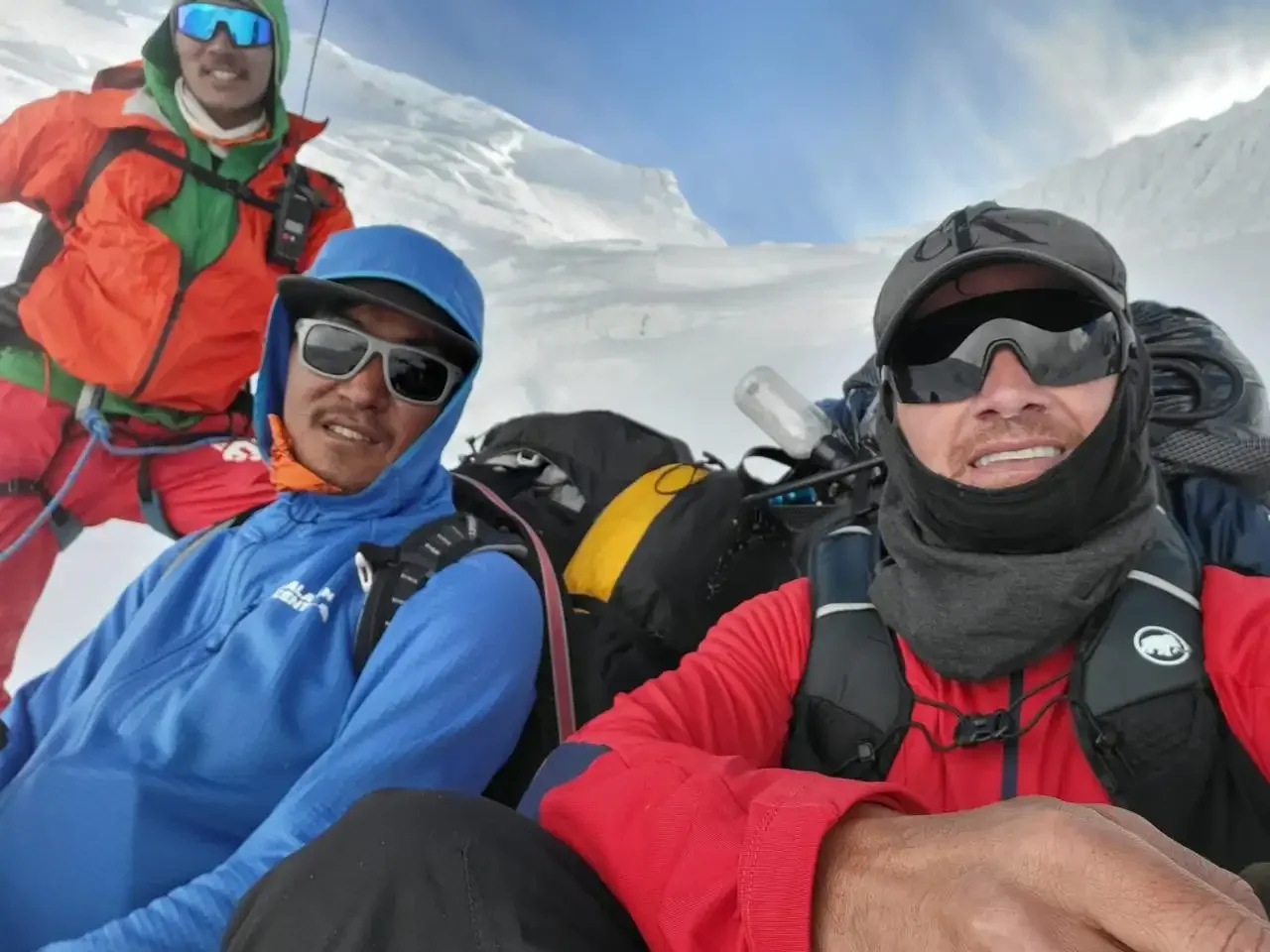
{"time":1783533466190,"blocks":[{"id":"xaGMkhWKDl","type":"paragraph","data":{"text":"Stand at 8,163 meters and you are looking down on Earth. Below you, the Budhi Gandaki valley cuts a\ndeep green line toward the plains. To the west, the Annapurna range holds its\nfamiliar shape. This is the summit of <a href=\"https:\/\/expeditionhimalaya.com\/package\/manaslu-expedition\/\">Manaslu<\/a>,\nthe eighth highest mountain in the world, and one of the most respected\n8,000-meter climbs a mountaineer can attempt."}},{"id":"hME3UfKE7t","type":"paragraph","data":{"text":"Manaslu sits in the Mansiri Himal of west-central\nNepal, rising above the Budhi Gandaki Valley in Gorkha district. The name comes\nfrom the Sanskrit word \u201cmanasa,\u201d meaning intellect or soul, and Nepali climbers\noften call it the Mountain of the Spirit. It was first climbed on May 9, 1956,\nby Toshio Imanishi and Gyalzen Norbu Sherpa on a Japanese expedition that\nopened the Northeast Face route still used by most climbers today."}},{"id":"Bn6XEn7f1Q","type":"paragraph","data":{"text":"For mountaineers building toward an 8,000-meter\ncareer, Manaslu occupies a particular place. Its standard route is long on snow\nand glacier travel rather than technical rock or ice, which makes it one of the\nmore approachable 8000ers when conditions cooperate. That does not mean it is\neasy. The mountain has a serious history, including a major avalanche in 2012,\nand every climber on it needs real preparation, patience, and respect for the\nterrain. For climbers who have already stood above 7,000 meters on a peak like\n<a href=\"https:\/\/expeditionhimalaya.com\/package\/himlung-himal-expedition\/\" target=\"_blank\" rel=\"nofollow\">Himlung Himal <\/a>and are ready for their first 8,000-meter summit, Manaslu is\noften the natural next step."}},{"id":"LiRU519Kj5","type":"image","data":{"url":"https:\/\/media.tripcart.com\/images\/2552\/web_2552_1783424573_771610_5353_2599x1733.webp","caption":"A closer look at the world's eighth-highest mountain. Manaslu never fails to impress.","alt":"Manaslu 2","width":1063,"height":709,"withBorder":false,"withBackground":false,"stretched":false}},{"id":"QuMpOYPzsY","type":"header","data":{"text":"Manaslu at a\nGlance","level":2}},{"id":"r7-UVIGAnc","type":"table","data":{"withHeadings":false,"stretched":false,"content":[["<b>Summit Altitude<\/b>\n ","<b>8,163m \/ 26,781ft (8th highest mountain in the world)<\/b>\n "],["Location\n ","Mansiri Himal, Gorkha District, Gandaki Province, Nepal\n "],["Mountain Range\n ","Mansiri Himal, west-central Nepal\n "],["First Ascent\n ","May 9, 1956, Toshio Imanishi and Gyalzen Norbu Sherpa (Japanese\n expedition), Northeast Face\n "],["Standard Route\n ","Northeast Face \/ Northeast Ridge\n "],["Duration\n ","Approximately 36 days (Kathmandu to Kathmandu)\n "],["Climbing Period\n ","Approximately 19 days at and above Base Camp\n "],["Best Season\n ","Autumn (September to November)\n "],["Base Camp\n ","Approximately 4,700m\n "],["High Camps\n ","Camp 1: ~5,700m | Camp 2: ~6,400m | Camp 3: ~6,800m | Camp 4:\n ~7,400m\n "],["Supplemental Oxygen\n ","Used by most climbers above Camp 3 or Camp 4\n "],["Prerequisites\n ","Prior summit of a 7,000m peak strongly recommended (Himlung\n Himal, Baruntse, or similar)\n "]]}},{"id":"m9atI2Whq6","type":"header","data":{"text":"Why Manaslu?\nWhat Makes This Peak So Special","level":2}},{"id":"uLOxrWD0CJ","type":"paragraph","data":{"text":"Nepal has eight 8,000-meter peaks, and each one\nhas earned its own reputation. Everest draws the crowds. Makalu and Lhotse\ndemand serious technical skill. Manaslu occupies different ground. It is\nrespected as an achievable first 8,000er for well-prepared climbers, while\nstill commanding the seriousness that any mountain above 8,000 meters deserves."}},{"id":"BMvRvGGDD8","type":"paragraph","data":{"text":"<b>The standard route rewards preparation over\ntechnical wizardry<\/b>"}},{"id":"wYTDoIR5Gx","type":"paragraph","data":{"text":"<b><\/b>The\nNortheast Face route follows long snow and glacier slopes rather than sustained\nrock climbing or vertical ice. Fixed ropes are placed on the steeper sections\nabove Camp 2, and climbers with solid crampon technique, glacier travel\nexperience, and a 7,000m peak already on their resume tend to move through the\nroute with confidence. This does not remove the danger. The glacier between\nCamp 1 and Camp 2 has an active icefall, and large seracs hang above parts of\nthe upper mountain. Respect for the terrain matters as much as fitness."}},{"id":"G2nbDCzDjf","type":"paragraph","data":{"text":"<b>The approach is a journey through one of Nepal's\nmost culturally rich valleys<\/b>"}},{"id":"Uqy3po8uYc","type":"paragraph","data":{"text":"<b> <\/b>The trek to Base Camp follows the Budhi Gandaki\nRiver through Machha Khola, Philim, Namrung, and Sama Gaun, villages shaped by\ncenturies of Tibetan Buddhist influence. Stone houses, mani walls, and\nmonasteries line the trail. Sama Gaun itself sits beneath Manaslu's towering\nnorth face, and for many climbers, the days spent walking through this valley\nare as memorable as the climb itself."}},{"id":"CUzHo1w0RZ","type":"paragraph","data":{"text":"<b>Larke Pass adds a genuine high mountain crossing\nto the itinerary<\/b>"}},{"id":"66UIDNvwYK","type":"paragraph","data":{"text":"<b> <\/b>At\nroughly 5,160m, Larke Pass connects the Manaslu region to the Annapurna side\nnear Dharapani, and Expedition Himalaya's route uses this crossing as part of\nthe approach, with views that take in Himlung Himal and the wider Manaslu\nmassif. It is a serious trekking day on its own."}},{"id":"9_gr_5uAdK","type":"paragraph","data":{"text":"<b>The summit view justifies every step.<\/b>"}},{"id":"p-huNJ8prb","type":"paragraph","data":{"text":"<b><\/b>From 8,163m, the panorama\ntakes in the Annapurna range, Ganesh Himal, and on clear days, a horizon that\nseems to fold in every direction. Climbers who reach the top of Manaslu\ndescribe it as one of the most complete Himalayan experiences available, combining\nserious mountaineering with genuine cultural depth on the way in."}},{"id":"WtxHia_3Ie","type":"image","data":{"url":"https:\/\/media.tripcart.com\/images\/2552\/web_1768983150_480714_2096_85_1280x960.webp","caption":"The mountain summit may be the destination, but the team is the strength behind every successful ascent.","alt":"IMG-20251217-WA0066","width":1063,"height":797,"withBorder":false,"withBackground":false,"stretched":false}},{"id":"hs6qbjO6pf","type":"header","data":{"text":"Why Autumn Is\nthe Best Season for Manaslu","level":2}},{"id":"hKvUJ0Fsab","type":"paragraph","data":{"text":"Manaslu can be attempted in both spring and\nautumn, but autumn is where this mountain has built its reputation. Industry\nfigures consistently show higher summit rates in the autumn season compared to\nspring, largely because of the weather pattern that settles over Nepal once the\nmonsoon clears."}},{"id":"ORY0tg6Mqb","type":"paragraph","data":{"text":"From mid-September onward, the Himalaya enters its\nmost stable period of the year. Skies clear, winds moderate, and the fresh snow\nleft behind by the monsoon settles into a more predictable surface for\nclimbing. Expedition teams use this window to run their rotations and time\nsummit pushes with much better visibility into what the mountain is going to\ndo."}},{"id":"dtfUPwLZ2n","type":"table","data":{"withHeadings":false,"stretched":false,"content":[["<b>Why Autumn Works So Well<\/b>\n ","<b>What to Keep in Mind<\/b>\n "],["Post-monsoon skies are clear and stable, ideal for route finding\n and summit windows\n ","Late autumn (into November) can bring sudden cold snaps and high\n winds\n "],["Fresh snow from the monsoon provides good footing on lower\n glacier sections\n ","The icefall between Camp 1 and Camp 2 remains active regardless\n of season\n "],["Historically higher summit success than spring, according to\n industry-reported figures\n ","Nights at Base Camp regularly drop below minus 10\u00b0C, and higher\n camps are colder still\n "],["Government season classification treats autumn as Manaslu's\n primary climbing period\n ","More teams on the mountain in autumn than spring, though still\n far fewer than on Everest\n "],["Clear visibility on the Larke Pass crossing and throughout the\n Budhi Gandaki approach\n ","Rope-fixing and camp setup depend on weather-dependent Sherpa\n teams working in sequence\n "]]}},{"id":"_ziRmbJyio","type":"paragraph","data":{"text":"At Expedition Himalaya, autumn has always been our\nprimary Manaslu season. The stable weather window, combined with a well-rested\nand well-acclimatized team, gives climbers the best realistic chance of a safe\nsummit."}},{"id":"Kh8SjlO1CM","type":"header","data":{"text":"The Route: From\nKathmandu to the Summit, Step by Step","level":2}},{"id":"L-4gtmUyxb","type":"header","data":{"text":"Phase 1: The Approach Trek (Days\n1 to 10)","level":3}},{"id":"eAuVHJ4JPe","type":"paragraph","data":{"text":"The expedition begins with two days in Kathmandu\nfor arrival, rest, permit processing, and an expedition briefing covering the\nroute, acclimatization plan, and safety procedures. From there, the team drives\nto Besisahar and continues by jeep to Dharapani, where the Manaslu and\nAnnapurna regions meet."}},{"id":"WVtpPXtR6s","type":"paragraph","data":{"text":"Trekking begins from Dharapani, moving through\nGowa and up into the alpine basin of Bhimthang (3,720m), where a rest day\nallows the body to begin adjusting to altitude. The trail then climbs to Larke\nPass (approximately 5,160m), the highest point of the entire approach, before\ndescending to the Tibetan-influenced village of Samdo. From Samdo, the route\ndrops to Sama Gaun (3,541m), a major village directly beneath Manaslu's north\nface, and finally climbs to Manaslu Base Camp at approximately 4,700m."}},{"id":"my4dj-DINz","type":"header","data":{"text":"Phase 2: Acclimatization and\nRotations (Days 11 to Roughly 24)","level":3}},{"id":"iWV9qY2otW","type":"paragraph","data":{"text":"Once the team is settled at Base Camp, a\ntraditional puja ceremony asks the mountain for a safe expedition before any\nclimbing begins. The following days are built around acclimatization rotations\nbetween Base Camp and the higher camps."}},{"id":"eD6ZDu-vsI","type":"paragraph","data":{"text":"Camp 1 at approximately 5,700m is reached across\nglaciated ground and an active icefall section that requires careful route\nfinding and fixed-rope use. Camp 2 at approximately 6,400m sits above steeper\nglacier terrain, and by this stage climbers are spending their first nights\nwell above 6,000 meters. Load carrying, rope fixing on the steeper pitches, and\nrepeated rotations between camps allow the body to build the red blood cells\nneeded for the extreme altitude above. Rest days at Base Camp between rotations\nare used for recovery, hydration, and close monitoring of health and weather."}},{"id":"9hlDWLD5hY","type":"header","data":{"text":"Phase 3: The Summit Push (Final\nDays of the Climbing Period)","level":3}},{"id":"N8ouTcsIxK","type":"paragraph","data":{"text":"When the weather window opens and the team is\nproperly acclimatized, the summit push begins. Climbers move from Base Camp\nthrough Camp 1 and Camp 2, continuing to Camp 3 at approximately 6,800m, and\nfinally to Camp 4 at approximately 7,400m, the summit camp."}},{"id":"9cTn1C-2Xz","type":"paragraph","data":{"text":"Camp 4 is occupied only briefly. Most teams begin\nthe final push in the middle of the night to reach the summit in stable morning\nconditions and descend before afternoon winds build. Many climbers use\nsupplemental oxygen from Camp 3 or Camp 4 onward, a standard and sensible\npractice at this altitude, where the air holds roughly a third of the oxygen\navailable at sea level. The final slopes below the summit are long and\nphysically demanding rather than technically extreme, but the altitude makes\nevery step deliberate. After summiting, the team descends back through the\ncamps to Base Camp, then retraces the classic Budhi Gandaki trekking route down\nthrough Namrung, Philim, and Dharapani before driving back to Kathmandu."}},{"id":"vy_LrNmHsZ","type":"image","data":{"url":"https:\/\/media.tripcart.com\/images\/2552\/web_1768983081_927850_6597_85_1280x960.webp","caption":"A shared journey through the Himalayas. Climber and Sherpa working together towards the summit of Manaslu.","alt":"IMG-20251217-WA0069","width":1063,"height":797,"withBorder":false,"withBackground":false,"stretched":false}},{"id":"pC75rPEYmB","type":"header","data":{"text":"Who Should Climb\nManaslu? The Ideal Candidate","level":2}},{"id":"81rVdx_imq","type":"paragraph","data":{"text":"Manaslu is sometimes described as one of the more\nachievable 8,000-meter peaks, and that description is fair, but it should never\nbe read as \u201ceasy.\u201d Here is who is genuinely well suited to this expedition:"}},{"id":"8ZjKQ7wH8N","type":"paragraph","data":{"text":"<b>Climbers with 7,000m experience: <\/b>Expedition Himalaya\nstrongly recommends a prior summit of a 7,000m peak such as <a href=\"https:\/\/expeditionhimalaya.com\/package\/himlung-himal-expedition\/\" target=\"_blank\" rel=\"nofollow\">Himlung Himal<\/a>,\n<a href=\"https:\/\/expeditionhimalaya.com\/package\/baruntse-amphu-lapcha-expedition\/\" target=\"_blank\" rel=\"nofollow\">Baruntse<\/a>, Putha Hiunchuli, or Tilicho Peak before attempting Manaslu. Time\nspent above 6,500m in an expedition setting builds the physical and mental\nfoundation this climb demands."}},{"id":"OgNKL3Y-Nc","type":"paragraph","data":{"text":"<b>Climbers with solid glacier and rope skills: <\/b>You should be entirely\ncomfortable with crampons, fixed ropes, and glacier travel, including crossing\ncrevassed terrain roped up or on ladders where needed."}},{"id":"fZT8QKDKkX","type":"paragraph","data":{"text":"<b>Climbers looking for their first 8,000m summit: <\/b>Manaslu's relatively\nstraightforward standard route makes it a common choice for climbers stepping\nup from 7,000m peaks into 8,000m territory for the first time."}},{"id":"bDXIiPG05Y","type":"paragraph","data":{"text":"<b>Trekkers with strong Himalaya experience wanting\nmore: <\/b>If\nyou have completed demanding treks like the Manaslu Circuit or Annapurna\nCircuit and want to move into serious mountaineering, Manaslu is a significant\nstep up, best approached after building peak-climbing experience first rather\nthan as a first expedition."}},{"id":"VRSc7FXsPY","type":"paragraph","data":{"text":"<b>Physical requirements: <\/b>You should be able to trek\nand climb for 6 to 10 hours a day over multiple consecutive weeks, carrying a\npack. We recommend a minimum of 4 to 6 months of structured training, combining\ncardiovascular endurance, leg strength, and practice with crampons and ice axes\nwherever possible."}},{"id":"YM7dNK-_i3","type":"header","data":{"text":"Permits,\nLogistics, and What Is Included","level":2}},{"id":"AsDl01n_N4","type":"paragraph","data":{"text":"Manaslu lies within a restricted area and a\nconservation area, so permits and logistics require careful planning well\nbefore departure."}},{"id":"J_e6J_lGJR","type":"table","data":{"withHeadings":false,"stretched":false,"content":[["<b>Permit \/ Requirement<\/b>\n ","<b>Details<\/b>\n "],["Climbing Royalty (MoCTCA)\n ","Government mountaineering royalty (Autumn Season): USD 3,000 per person for peaks above 8,000m. Rates are determined by the Government of Nepal\n "],["Restricted Area Permit (Manaslu)\n ","Approximately USD 100 for the first 7 days plus USD 15 per\n additional day during autumn (September to November)\n "],["Manaslu Conservation Area Permit (MCAP)\n ","Approximately USD 30\n "],["Annapurna Conservation Area Permit (ACAP)\n ","Approximately USD 30 (required for the Dharapani approach)\n "],["Government Liaison Officer\n ","Required by law for expeditions above 6,500m. Arranged and\n provided by Expedition Himalaya.\n "],["Licensed Climbing Guide \/ Sherpa\n ","Government-recognized climbing Sherpa required for the ascent\n "],["Garbage Deposit and Rope-Fixing Fee\n ","Required by the Nepal government. Refundable portion applies to\n proper waste disposal.\n "]]}},{"id":"sI4F9N58zS","type":"paragraph","data":{"text":"All permits, royalty processing, and liaison\nofficer coordination are handled by Expedition Himalaya. You focus on training.\nWe take care of the paperwork."}},{"id":"6GSCzEmGEw","type":"header","data":{"text":"Autumn 2026\nFixed Departure Dates","level":2}},{"id":"RyeG5rywVp","type":"alert","data":{"type":"info","align":"left","message":"Expedition Himalaya is running a <span style=\"\" data-empty=\"false\"><a href=\"https:\/\/expeditionhimalaya.com\/package\/manaslu-expedition\/#availability\" target=\"_blank\" rel=\"nofollow\">fixed departure<\/a><\/span> Manaslu Expedition for Autumn 2026, departing September 7, 2026, with a 36-day itinerary from Kathmandu back to Kathmandu<div data-empty=\"true\"><br><\/div><div data-empty=\"false\">What is included: airport transfers, 4 nights in a Kathmandu hotel with welcome and farewell dinners, Kathmandu sightseeing, all government permits and royalty fees, garbage deposit and rope-fixing charges, a liaison officer, Base Camp accommodation in an individual sleeping tent with full board meals, shared tent accommodation at the higher camps, a 1:1 climbing Sherpa per member, three bottles of supplemental oxygen per member and two for the accompanying climbing Sherpa with mask and regulator, high-calorie climbing food, and a summit certificate on success.<\/div><div data-empty=\"true\"><br><\/div><div data-empty=\"false\">An optional helicopter return to Kathmandu from Samagaun is available at additional cost for climbers who want to skip the return trek. Fixed departures mean shared permit costs and a ready-made team. <\/div><div data-empty=\"false\">Contact us to reserve a place or to discuss a private departure on custom dates.<\/div>"}},{"id":"O5pQT-5Suu","type":"header","data":{"text":"What to Expect\nHonestly: The Realities of an 8,000m Expedition","level":2}},{"id":"2ZN7a-XfP6","type":"paragraph","data":{"text":"Manaslu is often regarded as one of the more accessible 8,000m peaks, but it remains a serious Himalayan expedition where sound judgment, strong acclimatization, and disciplined decision-making are essential. Every season presents objective hazards and environmental challenges that demand respect."}},{"id":"qNUW74j-Md","type":"paragraph","data":{"text":"<strong>High-altitude environment: <\/strong>Above 7,000m, climbers enter an environment where physiological performance declines rapidly despite acclimatization. Summit day takes place entirely within the death zone, where prolonged exposure significantly increases physical and cognitive fatigue. Supplemental oxygen is commonly used from the upper camps, but it should be viewed as a safety margin rather than a substitute for proper acclimatization and fitness."}},{"id":"_9zhY01iz5","type":"paragraph","data":{"text":"<strong>Cold and severe weather: <\/strong>Temperatures at Base Camp routinely fall below -10\u00b0C, while summit rotations commonly experience temperatures below -20\u00b0C, with wind chill making conditions considerably harsher. Rapid weather changes, jet stream influence, and high winds can alter climbing conditions within hours, making flexibility and patience critical throughout the expedition."}},{"id":"rP7IGUDWXT","type":"paragraph","data":{"text":"<strong>Objective hazards: <\/strong>The Northeast Ridge presents objective hazards that cannot be eliminated. The route passes through glaciated terrain with crevasses, serac exposure, avalanche-prone slopes, and sections that require fixed ropes. Snowpack stability varies throughout the season, and route conditions may change significantly following snowfall, warming temperatures, or wind loading. Safe progress depends on continuous route assessment, experienced leadership, and conservative decision-making."}},{"id":"1UxIBGQRnb","type":"paragraph","data":{"text":"<strong>Expedition life: <\/strong>Following the trekking approach, life shifts to a traditional Himalayan expedition environment. Base Camp serves as the operational hub for several weeks, while higher camps are established progressively during acclimatization rotations. Living conditions are basic, with accommodation in expedition tents, limited personal comforts, and communication dependent on satellite or camp-based systems."}},{"id":"kkxiuvrNWP","type":"paragraph","data":{"text":"<strong>Physical and mental demands: <\/strong>Repeated carries between camps, prolonged exposure to altitude, interrupted sleep, reduced appetite, dehydration, and cumulative fatigue are expected components of an 8,000m expedition. Successful climbers manage energy efficiently, recover well between rotations, and maintain consistent decision-making even under physical stress."}},{"id":"XLqsHPiSKo","type":"paragraph","data":{"text":"<strong>Summit strategy: <\/strong>Summit success depends on the convergence of favorable weather, team strength, route conditions, and individual health. A successful expedition is measured not only by reaching the summit but by making sound decisions throughout the climb. Turning back when conditions deteriorate or when safety margins become unacceptable is an integral part of responsible high-altitude mountaineering."}},{"id":"4kNPijvam-","type":"header","data":{"text":"Why Climb\nManaslu with Expedition Himalaya?","level":2}},{"id":"eKi43aAGGD","type":"list","data":{"style":"unordered","items":[{"content":"Over 15 years running treks and expeditions across Nepal, from 6,000m trekking peaks to the summit of Everest (8,848.86m), with a government-certified operator license (Registration No. 8817\/068\/069) that covers restricted area access and expedition permitting.","items":[]}]}},{"id":"DSWwTM7TrQ","type":"list","data":{"style":"unordered","items":[{"content":"Our climbing Sherpa team brings genuine high-altitude experience, including multiple 8,000m summits. Our Expedition Director, Da Gelje Sherpa, has summited Everest seven times.","items":[]}]}},{"id":"tgjaabi7In","type":"list","data":{"style":"unordered","items":[{"content":"Safety comes before schedule. We build conservative acclimatization rotations, carry emergency oxygen and medical kits, monitor weather daily, and make turnaround calls based on conditions, not sunk costs.","items":[]}]}},{"id":"c7Yb7NWjW-","type":"list","data":{"style":"unordered","items":[{"content":"Complete logistics are handled from arrival to departure: airport transfers, Kathmandu accommodation, all ground transport, porters, a fully equipped Base Camp with heated dining space, high camp tents and supplies, and a summit certificate on success.","items":[]}]}},{"id":"vMj-2L8WIv","type":"list","data":{"style":"unordered","items":[{"content":"We support you well before you land in Nepal, with a detailed gear list, training guidance, and direct answers to your questions in the months of preparation leading up to departure.","items":[]}]}},{"id":"PORhEZorzN","type":"header","data":{"text":"Manaslu as Your\nFirst 8,000m Summit: What Comes Next?","level":2}},{"id":"O3spz7hFMu","type":"paragraph","data":{"text":"For many climbers, Manaslu is not the end of the\nstory. It is proof that an 8,000-meter summit is within reach. After a\nsuccessful climb, you carry forward real experience with extreme altitude,\nsupplemental oxygen use, multi-week expedition logistics, and decision-making\nunder genuinely serious conditions."}},{"id":"tcKsyds7GT","type":"paragraph","data":{"text":"That experience matters. Expedition leaders on\npeaks like <a href=\"https:\/\/expeditionhimalaya.com\/package\/cho-oyu-expedition\/\" target=\"_blank\" rel=\"nofollow\">Cho Oyu<\/a>, <a href=\"https:\/\/expeditionhimalaya.com\/package\/everest-expedition\/\" target=\"_blank\" rel=\"nofollow\">Everest<\/a>, and <a href=\"https:\/\/expeditionhimalaya.com\/package\/lhotse-expedition\/\" target=\"_blank\" rel=\"nofollow\">Lhotse<\/a> look for climbers with a confirmed\n8,000m summit already on their record, because it tells them how a climber\nperforms when the stakes are real. We have supported climbers who moved from\nManaslu into an Everest attempt within a season or two, applying the lessons\nlearned on the Northeast Face route directly to their next mountain. If your\nambitions run toward the highest peaks on Earth, Manaslu is where that path becomes\ncredible."}},{"id":"TT0ViuUL_R","type":"header","data":{"text":"Frequently Asked\nQuestions About Manaslu Expedition","level":2}},{"id":"2wb_F2z0M0","type":"paragraph","data":{"text":"<b>Q: How difficult is the Manaslu Expedition\ncompared to other 8,000m peaks?<\/b>"}},{"id":"_ZhgViwNxp","type":"paragraph","data":{"text":"A: Manaslu is generally considered one of the more\nachievable 8,000-meter peaks because its standard Northeast Face route is\nlargely a long snow and glacier climb rather than a sustained technical route.\nThat said, it remains an extremely demanding expedition. Prior experience above\n6,500 to 7,000 meters, solid crampon and fixed-rope skills, and genuine\nphysical conditioning are all necessary."}},{"id":"scGcs-ZL5L","type":"paragraph","data":{"text":"<b>Q: What is the summit success rate on Manaslu?<\/b>"}},{"id":"SsAMGZiE89","type":"paragraph","data":{"text":"A: Industry-reported figures put autumn summit\nsuccess in the range of roughly 60 to 80 percent in favorable years, generally\nhigher than spring attempts. Actual outcomes vary significantly year to year\nbased on weather, snow conditions, and team preparation, so any figure should\nbe treated as an estimate rather than a guarantee."}},{"id":"xAo2E4Dksz","type":"paragraph","data":{"text":"<b>Q: Why is autumn the best season for Manaslu?<\/b>"}},{"id":"-nA1ZF7FLQ","type":"paragraph","data":{"text":"A: Autumn (September to November) follows the\nmonsoon and brings Nepal's most stable weather of the year: clearer skies, more\npredictable wind patterns, and settled fresh snow on the lower glacier. Nepal's\ngovernment also treats autumn as Manaslu's primary climbing season."}},{"id":"PsphGBa9YL","type":"paragraph","data":{"text":"<b>Q: How long does the Manaslu expedition take?<\/b>"}},{"id":"zVZmMq9u6X","type":"paragraph","data":{"text":"A: Expedition Himalaya's Manaslu Expedition runs\napproximately 36 days from Kathmandu back to Kathmandu, including around 10\ndays for the approach trek, roughly 19 days for the climbing period at and\nabove Base Camp, and the remaining days for return trekking, driving, and\nKathmandu arrival and departure."}},{"id":"OKsT6ZDcg7","type":"paragraph","data":{"text":"<b>Q: Do I need supplemental oxygen on Manaslu?<\/b>"}},{"id":"xiAOuf5V4q","type":"paragraph","data":{"text":"A: Most climbers use supplemental oxygen from Camp\n3 or Camp 4 onward. While some highly experienced mountaineers climb without\nit, using oxygen at this altitude is a standard, sensible safety practice, and\nour packages include oxygen bottles for both members and climbing Sherpas."}},{"id":"Q3Ycdc7jKo","type":"paragraph","data":{"text":"<b>Q: What training should I do before attempting\nManaslu?<\/b>"}},{"id":"UyY6nIaCH-","type":"paragraph","data":{"text":"A: We recommend at least 4 to 6 months of\nstructured training, combining cardiovascular endurance (running, cycling,\nstair climbing), leg and core strength work, and practical time with crampons\nand an ice axe. Completing a 7,000m peak such as Himlung Himal in the year\nbefore your Manaslu attempt is strongly advised."}},{"id":"PpFpsRXXFB","type":"paragraph","data":{"text":"<b>Q: What permits and government requirements apply\nto Manaslu?<\/b>"}},{"id":"oc7U7TYqse","type":"paragraph","data":{"text":"A: Manaslu requires a climbing royalty fee paid to\nNepal's Ministry of Culture, Tourism and Civil Aviation, a Manaslu Restricted\nArea Permit, a Manaslu Conservation Area Permit, an Annapurna Conservation Area\nPermit for the Dharapani approach, a government liaison officer, and a licensed\nclimbing guide. Expedition Himalaya arranges all of these as part of the\npackage."}},{"id":"3sPW6BlC4p","type":"paragraph","data":{"text":"<b>Q: What does the Expedition Himalaya Manaslu\npackage include?<\/b>"}},{"id":"SV7Zs4MloN","type":"paragraph","data":{"text":"A: Our package covers Kathmandu hotel\naccommodation, all ground transport, all government permits and royalty fees, a\nliaison officer, Base Camp and high camp accommodation, full board meals during\nthe trek and climbing period, a 1:1 climbing Sherpa, supplemental oxygen for\nmembers and Sherpas, and a summit certificate on success. International\nairfare, personal insurance, and the Sherpa summit bonus are not included."}},{"id":"PwafqpvsWP","type":"header","data":{"text":"Related Reading\nfrom Expedition Himalaya","level":2}},{"id":"z4PJziuM0r","type":"paragraph","data":{"text":"\u2022 <a href=\"https:\/\/expeditionhimalaya.com\/himlung-himal-expedition-autumn-nepal\/\">Himlung\nHimal Expedition: Your Gateway to High Altitude Mountaineering<\/a>"}},{"id":"MIUiqD6rnT","type":"paragraph","data":{"text":"\u2022 <a href=\"https:\/\/expeditionhimalaya.com\/nepals-new-everest-rule\/\">Nepal's New\nEverest Rule: Why Climbing a 7,000m Peak is Now Mandatory<\/a>"}},{"id":"RzPKf3WWIa","type":"paragraph","data":{"text":"\u2022 <a href=\"https:\/\/expeditionhimalaya.com\/expedition-and-trekking-gear-guide\/\">Complete\nGear Checklist for Himalayan Expeditions 2026<\/a>"}},{"id":"KIkAYwvqvY","type":"paragraph","data":{"text":"\u2022 <a href=\"https:\/\/expeditionhimalaya.com\/high-altitude-sickness\/\">Altitude\nSickness: Symptoms, Prevention and What To Do<\/a>"}}],"version":"2.31.0"}
Previous
Ama Dablam Expedition: The Complete Guide to Climbing Nepal's Most Beautiful Mountain
Next
Larkya North Peak Climbing (6,249m): The Manaslu Circuit's Natural Next Step