sales@expeditionhimalaya.com
+977 985-1004278
Customize Trip
All Packages
Trekking
Everest Region
Annapurna Region
Langtang Region
Makalu Region
Manaslu Region
Wilderness & Remote Trek
Expeditions
8000ers
7000ers
6000ers
Combo
Tours
Nepal Experiences
Scenic Helicopter Tours
Tibet
Information
Booking Terms and Conditions
Expedition & Trekking Gear Guide
Permit | Garbage
Nepal Travel & Visa Guide (Updated 2026)
Tibet Tour Guide Book
A Dining Guide by Expedition Himalaya
Company
About Expedition Himalaya
Meet the Team
Blog
Testimonials
Legal Documents
Contact Us
Traveler Login
Open main menu
Close menu
All Packages
Trekking
Everest Region
Annapurna Region
Langtang Region
Makalu Region
Manaslu Region
Wilderness & Remote Trek
Expeditions
8000ers
7000ers
6000ers
Combo
Tours
Nepal Experiences
Scenic Helicopter Tours
Tibet
Information
Booking Terms and Conditions
Expedition & Trekking Gear Guide
Permit | Garbage
Nepal Travel & Visa Guide (Updated 2026)
Tibet Tour Guide Book
A Dining Guide by Expedition Himalaya
Company
About Expedition Himalaya
Meet the Team
Blog
Testimonials
Legal Documents
Contact Us
Traveler Login
sales@expeditionhimalaya.com
+977 985-1004278
Customize Trip
All Packages
Trekking
Everest Region
Annapurna Region
Langtang Region
Makalu Region
Manaslu Region
Wilderness & Remote Trek
Expeditions
8000ers
7000ers
6000ers
Combo
Tours
Nepal Experiences
Scenic Helicopter Tours
Tibet
Information
Booking Terms and Conditions
Expedition & Trekking Gear Guide
Permit | Garbage
Nepal Travel & Visa Guide (Updated 2026)
Tibet Tour Guide Book
A Dining Guide by Expedition Himalaya
Company
About Expedition Himalaya
Meet the Team
Blog
Testimonials
Legal Documents
Contact Us
Traveler Login
Open main menu
Close menu
All Packages
Trekking
Everest Region
Annapurna Region
Langtang Region
Makalu Region
Manaslu Region
Wilderness & Remote Trek
Expeditions
8000ers
7000ers
6000ers
Combo
Tours
Nepal Experiences
Scenic Helicopter Tours
Tibet
Information
Booking Terms and Conditions
Expedition & Trekking Gear Guide
Permit | Garbage
Nepal Travel & Visa Guide (Updated 2026)
Tibet Tour Guide Book
A Dining Guide by Expedition Himalaya
Company
About Expedition Himalaya
Meet the Team
Blog
Testimonials
Legal Documents
Contact Us
Traveler Login
sales@expeditionhimalaya.com
+977 985-1004278
Customize Trip
Island Peak Climbing (6,189m): A Mountaineer's Guide to Imja Tse
Written by:
Niren Maharjan
Published On Jul 10, 2026
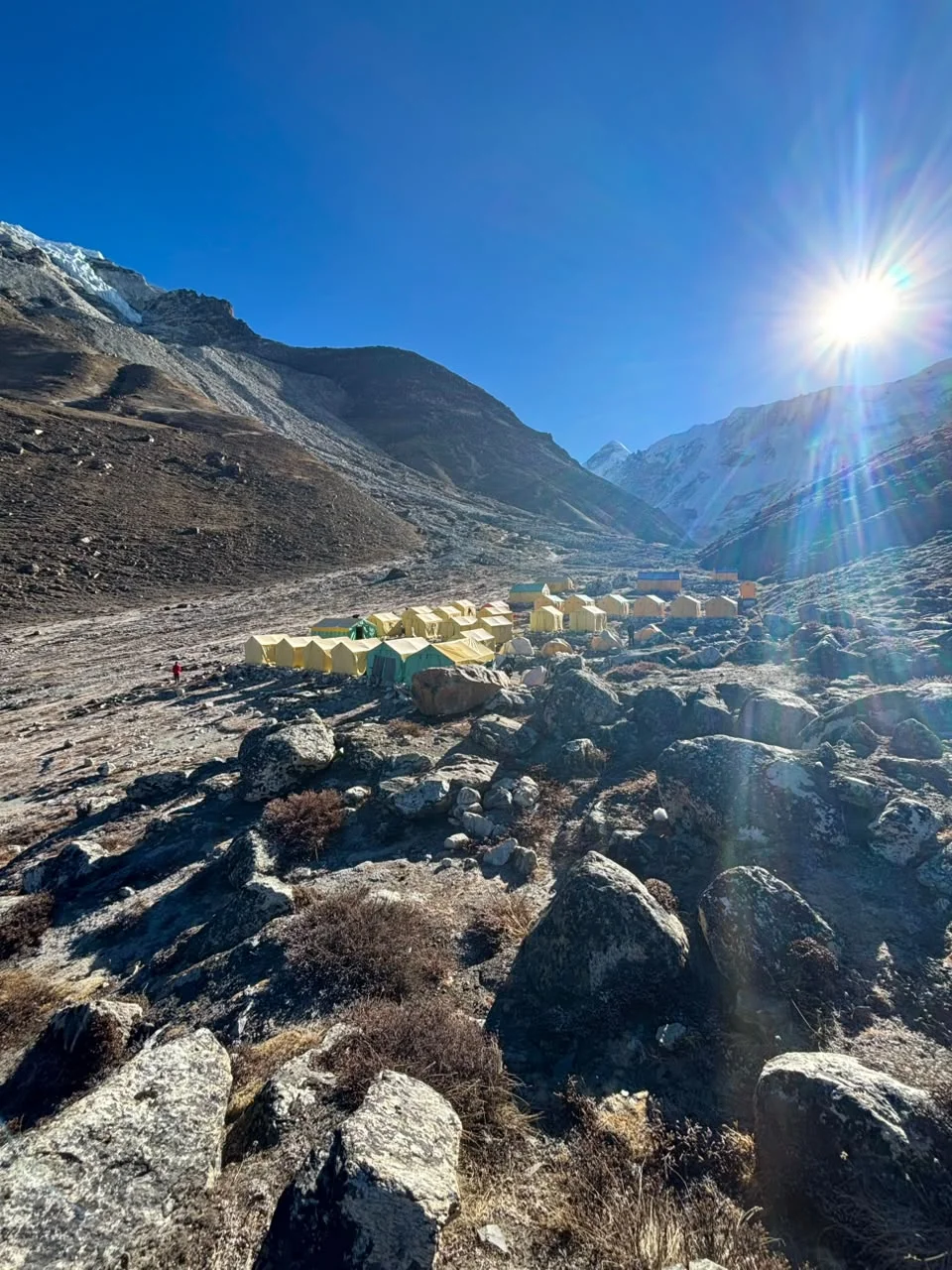
{"time":1783789216171,"blocks":[{"id":"5EQqh4Zwld","type":"paragraph","data":{"text":"Island Peak, known locally as\nImja Tse, rises to 6,189m at the head of the Imja Valley in Nepal's Everest\nregion. It is one of the most climbed peaks in the country, and also one of the\nmost historically significant, first summited in 1953 by members of the British\nEverest expedition as a training climb, months before Hillary and Tenzing\nreached the top of Everest itself."}},{"id":"If_tvJYsKu","type":"paragraph","data":{"text":"That history still shapes how\nthe mountain is climbed today. A roped glacier crossing leads to a genuine\nfixed-rope headwall, 200 to 300m of ice and rock at 40 to 50 degrees, followed\nby a narrow, exposed summit ridge. It is real technical climbing, not a\nscramble, which is exactly why Island Peak has become the standard introduction\nto mountaineering for trekkers moving beyond high-altitude trails. This guide\ncovers the route, the technical demands of the headwall, and how Island Peak\ncompares to Mera Peak and Lobuche East."}},{"id":"34I0thQ5Vh","type":"header","data":{"text":"Island Peak at a Glance","level":2}},{"id":"gs9Hoxnc2z","type":"table","data":{"withHeadings":false,"stretched":false,"content":[["<b>Summit\n Altitude<\/b>\n ","<b>6,189m \/\n 20,305ft<\/b>\n "],["Also Known As\n ","Imja Tse\n "],["Location\n ","Head of the\n Imja Valley, Everest region, Sagarmatha National Park\n "],["Technical\n Character\n ","A near-vertical\n fixed-rope headwall (roughly 200 to 300m at 40 to 50 degrees) on ice and\n rock, followed by a narrow, exposed summit ridge\n "],["First Ascent\n ","April 20, 1953,\n by Tenzing Norgay, Charles Evans, Alfred Gregory, Charles Wylie and Sherpa\n teammates, as a training climb for that year's British Everest expedition\n "],["Duration\n ","18 days\n (Kathmandu to Kathmandu)\n "],["Best Season\n ","Spring (March\n to May) and Autumn (September to November)\n "],["Base Camp\n ","Approximately\n 5,100m\n "],["Group Size\n ","2 to 10\n "],["Prerequisites\n ","Good general\n fitness and high-altitude trekking experience; technical skills are taught\n on-site\n "]]}},{"id":"Vx97fhpz6y","type":"header","data":{"text":"A Mountain That Trained the First Team to Climb Everest","level":2}},{"id":"dNtXvwVCG8","type":"paragraph","data":{"text":"Island Peak got its English name\nin 1952, when members of Eric Shipton's British reconnaissance expedition\nlooked down from Dingboche and saw the peak rising out of the surrounding\nglaciers like an island in a sea of ice. The following spring, members of the\nteam that would go on to make the first ascent of <a href=\"https:\/\/expeditionhimalaya.com\/package\/everest-expedition\/\" target=\"_blank\" rel=\"nofollow\">Everest<\/a> climbed to its summit\nas a deliberate training exercise, testing oxygen equipment, rehearsing rope\ntechnique and glacier navigation, and building the high-altitude endurance they\nwould need weeks later on Everest itself. Tenzing Norgay was on that climb."}},{"id":"su8q3xM4dN","type":"paragraph","data":{"text":"I like telling clients this\nhistory, because it explains something real about the mountain: Island Peak has\nfunctioned as a training and acclimatization objective for bigger Himalayan\nclimbs since before commercial mountaineering existed in Nepal. That is\nessentially still its role today, whether you are climbing it as your first\nreal peak or using it to prepare for something bigger."}},{"id":"OuMJiJnkxP","type":"header","data":{"text":"Where Island Peak Fits: Mera, Island Peak, or Lobuche East?","level":2}},{"id":"s5oZFwJrAo","type":"paragraph","data":{"text":"Of the three trekking peaks we\nguide most often in this region, Island Peak sits in the middle, and for most\nfirst-time climbers, that middle ground is exactly right."}},{"id":"qKTeiOEdF0","type":"paragraph","data":{"text":"<a href=\"https:\/\/expeditionhimalaya.com\/package\/mera-peak-climbing\/\" target=\"_blank\" rel=\"nofollow\">Mera Peak (6,476m)<\/a><b> is higher\nbut essentially non-technical, <\/b>a long roped glacier walk with a short\nfixed-rope section near the summit. If altitude alone is your main concern and\nyou are not looking for real vertical climbing, Mera is the gentler option."}},{"id":"nAKkwlF2UQ","type":"paragraph","data":{"text":"<a href=\"https:\/\/expeditionhimalaya.com\/package\/island-peak\/\" target=\"_blank\" rel=\"nofollow\">Island Peak<\/a><b> introduces you to\ngenuine technical climbing in a controlled, well-supported setting. <\/b>The\nheadwall, 200 to 300m of fixed rope on ice and rock at 40 to 50 degrees, is a\nreal climbing pitch, not a walk-up, and you ascend it with a jumar under close\nguidance. It is demanding, but it is also the most run, most understood route\nof the three, with strong infrastructure and experienced Sherpa support built\nup over decades."}},{"id":"_3ivMKtPeU","type":"paragraph","data":{"text":"<a href=\"https:\/\/expeditionhimalaya.com\/package\/lobuche-east-peak-climb\/\" target=\"_blank\" rel=\"nofollow\">Lobuche East (6,119m)<\/a><b> is more\ntechnical still, <\/b>graded PD+ against Island Peak's comparable difficulty,\nwith a steeper final wall and a more exposed summit ridge. It is generally the\nbetter choice for climbers who already have a technical peak or two behind\nthem, or who are specifically training for Everest or Lhotse."}},{"id":"AWrj79SMub","type":"paragraph","data":{"text":"My honest advice: if this is\nyour first attempt at anything beyond trekking, start with Island Peak. It\ngives you a real, serious taste of mountaineering, rope work, crampon\ntechnique, glacier crossing, exposure, without demanding prior technical\nexperience, and the route is supported by more infrastructure and more\nexperienced local teams than almost anywhere else in Nepal's trekking-peak\ncircuit."}},{"id":"Z1Lv4VDymu","type":"header","data":{"text":"The Technical Picture: What the Headwall Actually Involves","level":2}},{"id":"fupgELWFzC","type":"image","data":{"url":"https:\/\/media.tripcart.com\/images\/2552\/web_2552_1783788643_411245_9634_992x1280.webp","caption":"Roped glacier crossing below Island Peak headwall.","alt":"Summit Push - Island Peak","width":992,"height":1280,"withBorder":false,"withBackground":false,"stretched":false}},{"id":"LqC4_nwrk9","type":"paragraph","data":{"text":"The approach to Island Peak Base\nCamp (5,100m) follows the classic Everest Base Camp trail as far as Dingboche\nbefore turning south into the Imja Valley through Chhukung, so by the time you\nreach Base Camp you already carry solid acclimatization from Namche and\nDingboche."}},{"id":"CySoxSuKqd","type":"paragraph","data":{"text":"The climb itself has two\ndistinct phases. The lower section crosses a glacier, roped together as a team,\nnavigating crevasses that shift from season to season, technically\nstraightforward but requiring real attention and good rope discipline. Above\nthe glacier, the route reaches the headwall itself: a sustained pitch of fixed\nrope on ice and, in places, rock, at an angle of roughly 40 to 50 degrees,\nclimbed on ascender. This is the technical heart of the climb, and it is where\nprior crampon and jumar familiarity, even from a single day's practice, pays\noff. Above the headwall, a narrow, exposed summit ridge leads to the top, with\nreal drops on either side that demand careful, deliberate movement."}},{"id":"Xf3rShyuUD","type":"paragraph","data":{"text":"The whole summit day typically\nruns 10 to 14 hours round trip from Base Camp, which is as much a factor in the\nclimb's difficulty as the technical terrain itself. Fatigue late in a long day\nat altitude is when mistakes happen, which is exactly why our climbing Sherpas\nmanage pacing as carefully as they manage the rope systems."}},{"id":"PSglMQ7y7p","type":"header","data":{"text":"Best Season for Island Peak","level":2}},{"id":"0_HyqMBxz6","type":"table","data":{"withHeadings":false,"stretched":false,"content":[["<b>Why This\n Season Works<\/b>\n ","<b>What to Keep\n in Mind<\/b>\n "],["Spring (March\n to May) and autumn (September to November) offer the most stable weather and\n the best conditions on the headwall\n ","Base Camp\n (5,100m) has no permanent infrastructure; everything is carried in and set up\n fresh each season\n "],["Both windows\n keep the shared Everest Base Camp approach trail fully stocked with teahouses\n ","Headwall\n conditions vary year to year and even week to week; guides assess it fresh\n each summit attempt\n "],["Autumn\n generally gives the clearest views of Everest, Lhotse, Nuptse, and Ama Dablam\n from the summit ridge\n ","Temperatures at\n the headwall regularly sit below minus 15\u00b0C during the early start\n "],["Spring\n conditions on the glacier crossing tend to be firm and predictable\n ","A pre-climb\n training day at Base Camp is essential in either season, don't skip an\n itinerary that omits it\n "]]}},{"id":"jFCnQ1DOMb","type":"header","data":{"text":"The Route: From Kathmandu to the Summit","level":2}},{"id":"QsJgQ0htBB","type":"header","data":{"text":"Phase 1: The Classic Everest Approach (Days 1 to 8)","level":3}},{"id":"IFxoQzPOsO","type":"paragraph","data":{"text":"After arrival and preparation in\nKathmandu, the route follows the same trail used by every Everest Base Camp\ntrekker: Lukla to Phakding, Namche Bazaar with a rest day, Tengboche, and\nDingboche with a second rest day. This shared approach means you arrive at the\nbase of the climb already well acclimatized, which matters enormously on summit\nday."}},{"id":"k5OpeehO0s","type":"header","data":{"text":"Phase 2: Into the Imja Valley (Days 8 to 11)","level":3}},{"id":"ZBjN2t7XNg","type":"paragraph","data":{"text":"From Dingboche, the trail turns\naway from the main EBC route toward Chhukung (4,730m) and then Island Peak Base\nCamp (5,100m), with Imja Tse itself visible for most of the approach. A\ndedicated pre-climb training day at Base Camp covers crampon technique, jumar\nuse, and rope management under the direct supervision of your climbing Sherpa,\nregardless of your prior experience. This is not a formality; it is where the\nspecific skills for the headwall get rehearsed before you actually need them."}},{"id":"u9MG_ssFxL","type":"header","data":{"text":"Phase 3: Summit Day (Day 12)","level":3}},{"id":"baQStcZPJC","type":"paragraph","data":{"text":"Summit day begins in the early\nhours. The route crosses the glacier roped together, reaches the base of the\nheadwall, and climbs the fixed rope on ascender through the technical crux of\nthe climb. Above the headwall, the exposed summit ridge leads to the top, with\nviews across Lhotse, Nuptse, Makalu, and Ama Dablam opening up as you climb.\nAfter time on the summit, the descent, generally the more demanding half of the\nday both physically and technically, returns the team to Base Camp the same\nday."}},{"id":"aUjh45_Jj1","type":"header","data":{"text":"Phase 4: Back Through the Khumbu (Days 13 to 18)","level":3}},{"id":"stOZfos3Hz","type":"paragraph","data":{"text":"The return route retraces the\ntrail through Pangboche and Namche Bazaar to Lukla, with a flight back to\nKathmandu and a rest day before international departure."}},{"id":"srPvc-Wv6e","type":"header","data":{"text":"Required Gear for Island Peak","level":2}},{"id":"GRoJ5WaBfh","type":"paragraph","data":{"text":"This is a genuine technical\nclimb built around one significant obstacle, and the gear list reflects that\nreality. A climbing harness, ascender (jumar), descender, and helmet are\nessential, along with crampons and an ice axe used across the glacier for most\nof the summit day. Base Camp has no permanent infrastructure, so a four-season\nsleeping bag is necessary regardless of season. Insulated, crampon-compatible\nmountaineering boots and glacier glasses or goggles for the exposed ice\nsections are non-negotiable, given that the headwall sits in shadow for much of\nthe early morning and temperatures there regularly fall well below minus 15\u00b0C.\nAs with Lobuche East, this is a technical climb rather than a high-altitude\ntrek, so gear that is already broken in and familiar matters more here than on\nnon-technical peaks like Mera."}},{"id":"d_sS8DjTAN","type":"header","data":{"text":"Permits and What Is Included","level":2}},{"id":"I7gl0sj45s","type":"table","data":{"withHeadings":false,"stretched":false,"content":[["<b>Permit \/\n Requirement<\/b>\n ","<b>Details<\/b>\n "],["Island Peak\n Climbing Royalty\n ","NMA-issued\n climbing permit specific to Island Peak. Arranged by Expedition Himalaya.\n "],["Sagarmatha\n National Park Permit\n ","Required for\n the entire Everest region approach. Arranged by Expedition Himalaya.\n "],["Garbage Deposit\n ","Required by the\n Nepal government. Included in your package cost.\n "],["Licensed Guide\n and Climbing Sherpa\n ","English-speaking\n guide throughout, with one experienced climbing Sherpa for every two members\n during the summit push.\n "],["Summit\n Certificate\n ","Issued by the\n Nepal Mountaineering Association on successful ascent.\n "]]}},{"id":"muwfEj4thg","type":"paragraph","data":{"text":"Our package also includes\nairport transfers, a 4-star Kathmandu hotel, domestic flights to and from\nLukla, full board teahouse meals during the trek, high-altitude energy-rich\nmeals during the climbing phase, and comprehensive insurance coverage for our Sherpa\nand support staff, including helicopter evacuation. International airfare,\npersonal insurance for climbers, and tips are not included."}},{"id":"_yvmttU9Ic","type":"image","data":{"url":"https:\/\/media.tripcart.com\/images\/2552\/web_2552_1783788642_696187_8808_960x1280.webp","caption":"","alt":"Imja Lake - Island Peak","width":960,"height":1280,"withBorder":false,"withBackground":false,"stretched":false}},{"id":"9ZrJ4FP0Q1","type":"header","data":{"text":"Autumn 2026 Departures","level":2}},{"id":"zBEcj9-Zqu","type":"paragraph","data":{"text":"Expedition Himalaya runs fixed\nIsland Peak departures across spring and autumn, with Autumn 2026 group\ndepartures on September 2, October 2, and November 2. Group pricing starts at\nUSD 2,900 per person, with private solo 1:1 climbing arrangements available\nfrom USD 3,350. Contact us to confirm current availability and reserve a place."}},{"id":"puj7crimtf","type":"header","data":{"text":"What to Expect Honestly","level":2}},{"id":"L5dwvr2isS","type":"paragraph","data":{"text":"Island Peak is often marketed as\na beginner-friendly peak, and in relative terms, compared with a true\nexpedition, it is. But I want to be honest about what that means in practice.\nThe headwall is a real, sustained technical pitch, not a scramble, and climbing\nit for the first time, at over 5,500m, after an early alpine start in the cold,\nis genuinely demanding regardless of how much guidance you have. The 10 to 14\nhour summit day tests endurance as much as technique, and the descent, when\nlegs are tired and concentration slips, is where most incidents on this\nmountain actually happen. Weather at the headwall can turn conditions from firm\nand manageable to icy and slow within a single season, and our guides make that\ncall fresh each attempt rather than relying on how the route climbed the week\nbefore."}},{"id":"jR04gLFH5c","type":"header","data":{"text":"Why Climb Island Peak with Expedition Himalaya","level":2}},{"id":"gArZHiwE0D","type":"paragraph","data":{"text":"We treat the pre-climb training\nday at Base Camp as essential, not optional, because it is where climbers with\nno technical background actually learn the skills the headwall demands. Our\nclimbing Sherpas manage rope systems and pacing deliberately through the full\n10 to 14 hour summit day, not just the technical sections, because fatigue late\nin the day is where real risk builds. We are a government-registered operator\n(Registration No. 8817\/068\/069) with over 15 years running climbs across the\nEverest region, and Island Peak, given its history and its role as a genuine\nstepping stone, is one of the climbs we take the most care in preparing our\nclients for properly."}},{"id":"UXUGz2gims","type":"image","data":{"url":"https:\/\/media.tripcart.com\/images\/2552\/web_2552_1783788643_451112_4624_1280x960.webp","caption":"Island Peak Base Camp 5100m Imja Valley Everest region.","alt":"Island Peak Basecamp ","width":1063,"height":797,"withBorder":false,"withBackground":false,"stretched":false}},{"id":"O7LaDorSSA","type":"header","data":{"text":"Frequently Asked Questions About Island Peak Climbing","level":2}},{"id":"h_zs3YQj_V","type":"paragraph","data":{"text":"<b>Q: Is Island Peak a good\nfirst technical climb with no prior mountaineering experience?<\/b>"}},{"id":"GDLKj54cMz","type":"paragraph","data":{"text":"A: Yes, for most trekkers with\nsolid fitness and high-altitude experience. The technical skills, crampon use,\njumar ascent, rope management, are taught and rehearsed during a dedicated\ntraining day at Base Camp before the summit attempt. It is more technical than\nMera Peak but remains one of the most approachable genuine climbing objectives\nin Nepal."}},{"id":"esU69pizxH","type":"paragraph","data":{"text":"<b>Q: How does Island Peak\ncompare to Mera Peak and Lobuche East?<\/b>"}},{"id":"T21FLcvL59","type":"paragraph","data":{"text":"A: Mera Peak (6,476m) is higher\nbut essentially non-technical, a roped glacier walk. Island Peak (6,189m) adds\na genuine 200 to 300m fixed-rope headwall and is the classic first technical\nclimb. Lobuche East (6,119m) is lower but more technical still, graded PD+, and\nis often used specifically as Everest-preparation training."}},{"id":"3g0662b6G-","type":"paragraph","data":{"text":"<b>Q: What is the history behind\nIsland Peak's name and first ascent?<\/b>"}},{"id":"Dc_NizciFm","type":"paragraph","data":{"text":"A: It was named in 1952 by\nmembers of a British Everest reconnaissance team who saw it rising like an\nisland from a sea of glacial ice, viewed from Dingboche. It was first climbed\non April 20, 1953, by Tenzing Norgay and teammates from that year's British\nEverest expedition, as a training climb months before the first successful\nascent of Everest."}},{"id":"fW26IRywWU","type":"paragraph","data":{"text":"<b>Q: How long is summit day on\nIsland Peak?<\/b>"}},{"id":"Apm0PNvii_","type":"paragraph","data":{"text":"A: Typically 10 to 14 hours\nround trip from Base Camp, including the glacier crossing, the headwall, the\nsummit ridge, and the descent. Fatigue in the later stages is a real factor,\nwhich is why pacing is managed carefully by your climbing Sherpa throughout the\nday, not just on the technical sections."}},{"id":"sNFYbzq4LW","type":"paragraph","data":{"text":"<b>Q: What is the best season to\nclimb Island Peak?<\/b>"}},{"id":"w44PBhemgd","type":"paragraph","data":{"text":"A: Spring (March to May) and\nautumn (September to November), when weather is most stable and conditions on\nthe headwall are most predictable. Autumn generally offers the clearest summit\nviews."}},{"id":"-rAO-jj813","type":"paragraph","data":{"text":"<b>Q: Do I need my own technical\ngear, or can I rent it in Kathmandu?<\/b>"}},{"id":"5W3GSfSuOn","type":"paragraph","data":{"text":"A: Most technical equipment,\nharness, ascender, descender, helmet, crampons, and ice axe, can be rented in\nKathmandu. Given the technical nature of the headwall, we recommend at least\ntesting rented gear for fit and familiarity before the climb begins."}},{"id":"dAE23p16KL","type":"paragraph","data":{"text":"<b>Q: What does the Expedition\nHimalaya Island Peak package include?<\/b>"}},{"id":"pCtODB36a4","type":"paragraph","data":{"text":"A: Kathmandu hotel and airport\ntransfers, domestic flights to and from Lukla, all permits and government fees,\na licensed guide and climbing Sherpa support, full board meals during the trek,\nhigh-altitude meals during the climb, and comprehensive staff insurance\nincluding helicopter evacuation. International airfare and personal climber\ninsurance are not included."}},{"id":"C0Jh4kTIQG","type":"header","data":{"text":"Related Reading from Expedition Himalaya","level":2}},{"id":"VOFmFtz4ce","type":"paragraph","data":{"text":"\u2022 \n<a href=\"https:\/\/expeditionhimalaya.com\/mera-peak-climbing-guide-nepal\/\">Mera Peak\nClimbing: A Mountaineer's Complete Guide to Nepal's Highest Trekking Peak<\/a>"}},{"id":"75F9CwL2yI","type":"paragraph","data":{"text":"\u2022 \n<a href=\"https:\/\/expeditionhimalaya.com\/lobuche-east-climbing-guide\/\">Lobuche East\nClimbing: A Mountaineer's Guide to the Everest Region's Challenging Trekking Peak<\/a>"}},{"id":"1EUNCUiBpj","type":"paragraph","data":{"text":"\u2022 \n<a href=\"https:\/\/expeditionhimalaya.com\/nepals-new-everest-rule\/\">Nepal's New\nEverest Rule: Why Climbing a 7,000m Peak is Now Mandatory<\/a>"}},{"id":"GVe6Lczozm","type":"paragraph","data":{"text":"\u2022 \n<a href=\"https:\/\/expeditionhimalaya.com\/expedition-and-trekking-gear-guide\/\">Complete\nGear Checklist for Himalayan Expeditions 2026<\/a>"}}],"version":"2.31.0"}
Previous
Larkya North Peak Climbing (6,249m): The Manaslu Circuit's Natural Next Step
Next
Lobuche East Climbing (6,119m): A Mountaineer's Guide to the Everest Region's Challenging Trekking Peak