sales@expeditionhimalaya.com
+977 985-1004278
Customize Trip
All Packages
Trekking
Everest Region
Annapurna Region
Langtang Region
Makalu Region
Manaslu Region
Wilderness & Remote Trek
Expeditions
8000ers
7000ers
6000ers
Combo
Tours
Nepal Experiences
Scenic Helicopter Tours
Tibet
Information
Booking Terms and Conditions
Expedition & Trekking Gear Guide
Permit | Garbage
Nepal Travel & Visa Guide (Updated 2026)
Tibet Tour Guide Book
A Dining Guide by Expedition Himalaya
Company
About Expedition Himalaya
Meet the Team
Blog
Testimonials
Legal Documents
Contact Us
Traveler Login
Open main menu
Close menu
All Packages
Trekking
Everest Region
Annapurna Region
Langtang Region
Makalu Region
Manaslu Region
Wilderness & Remote Trek
Expeditions
8000ers
7000ers
6000ers
Combo
Tours
Nepal Experiences
Scenic Helicopter Tours
Tibet
Information
Booking Terms and Conditions
Expedition & Trekking Gear Guide
Permit | Garbage
Nepal Travel & Visa Guide (Updated 2026)
Tibet Tour Guide Book
A Dining Guide by Expedition Himalaya
Company
About Expedition Himalaya
Meet the Team
Blog
Testimonials
Legal Documents
Contact Us
Traveler Login
sales@expeditionhimalaya.com
+977 985-1004278
Customize Trip
All Packages
Trekking
Everest Region
Annapurna Region
Langtang Region
Makalu Region
Manaslu Region
Wilderness & Remote Trek
Expeditions
8000ers
7000ers
6000ers
Combo
Tours
Nepal Experiences
Scenic Helicopter Tours
Tibet
Information
Booking Terms and Conditions
Expedition & Trekking Gear Guide
Permit | Garbage
Nepal Travel & Visa Guide (Updated 2026)
Tibet Tour Guide Book
A Dining Guide by Expedition Himalaya
Company
About Expedition Himalaya
Meet the Team
Blog
Testimonials
Legal Documents
Contact Us
Traveler Login
Open main menu
Close menu
All Packages
Trekking
Everest Region
Annapurna Region
Langtang Region
Makalu Region
Manaslu Region
Wilderness & Remote Trek
Expeditions
8000ers
7000ers
6000ers
Combo
Tours
Nepal Experiences
Scenic Helicopter Tours
Tibet
Information
Booking Terms and Conditions
Expedition & Trekking Gear Guide
Permit | Garbage
Nepal Travel & Visa Guide (Updated 2026)
Tibet Tour Guide Book
A Dining Guide by Expedition Himalaya
Company
About Expedition Himalaya
Meet the Team
Blog
Testimonials
Legal Documents
Contact Us
Traveler Login
sales@expeditionhimalaya.com
+977 985-1004278
Customize Trip
Good Gear vs. Great Gear: The 5 Gears That Actually Matter in the Himalayas
Written by:
Niren Maharjan
Published On Mar 04, 2026
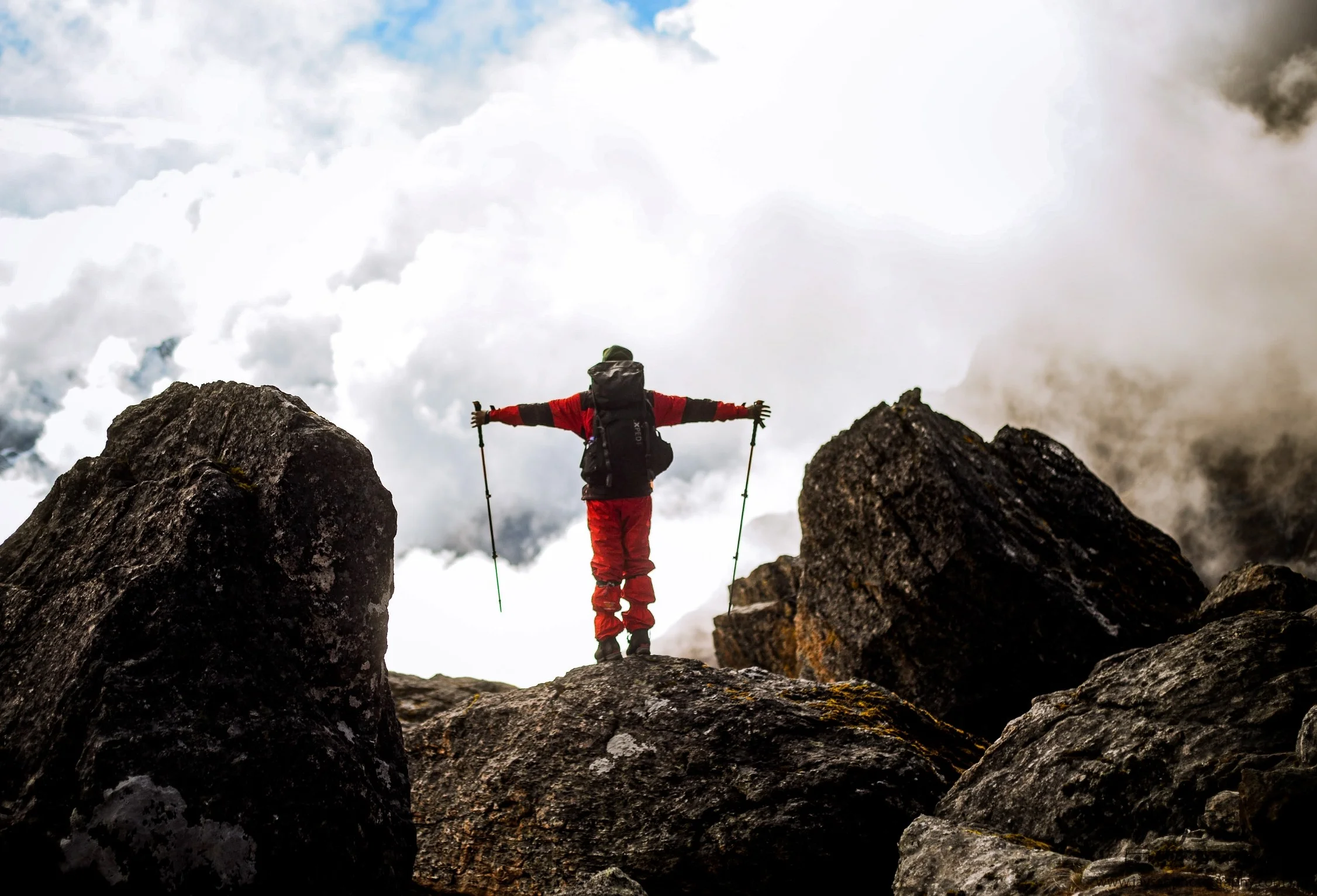
{"time":1773919952436,"blocks":[{"id":"J8tdwRf8ST","type":"paragraph","data":{"text":"The Himalayas have a way of exposing poor preparation quickly. A trail that looks manageable on a map becomes a different proposition above 4,000 meters when the temperature drops and the weather closes in. What works on a weekend hike in lower conditions does not always hold up across fourteen days at altitude."}},{"id":"I4Bk0183Ji","type":"paragraph","data":{"text":"We have guided climbers and trekkers across Nepal's mountains since 2011. In that time, we have learned that most equipment problems on the trail are not random. They concentrate in the same five categories, and they are almost always avoidable. Not by spending more on everything, but by being specific about where quality actually matters."}},{"id":"X_iBuNRxhP","type":"paragraph","data":{"text":"This is that list."}},{"id":"fmcnGEUvf6","type":"header","data":{"text":"1. Your Trekking Bag","level":2}},{"id":"yY5ZvMeKkb","type":"paragraph","data":{"text":"Your bag is on your back for six to eight hours a day, every day, for the\nduration of your trek. It affects your posture, your energy levels, your back,\nand your knees. A bag that does not fit properly is not just uncomfortable. It\nis a drain on the physical reserves you need at altitude.\n\n "}},{"id":"rspTG0iCl0","type":"header","data":{"text":"What to Look For","level":3}},{"id":"k_SlLh0ZLt","type":"paragraph","data":{"text":"<b>Capacity:<\/b> For most Himalayan treks, a 50-65L bag covers everything you need\nwithout becoming a burden. Go smaller if you are trekking with a porter for\nyour main duffel and only carrying a daypack yourself (25-35L is ideal in that\ncase)."}},{"id":"Km5xVdQvpt","type":"paragraph","data":{"text":"<b>\nFit system:<\/b> This is non-negotiable. The bag must have an adjustable torso\nlength, a hip belt that sits on your iliac crest (the top of your hip bone),\nand shoulder straps that do not gap away from your shoulders when loaded. A bag\nthat transfers weight properly to your hips rather than your shoulders will\nchange the experience completely."}},{"id":"lN2kgCX90L","type":"paragraph","data":{"text":"<b>\nFrame and back panel:<\/b> Look for an internal frame with an airflow back panel. At\naltitude you will sweat regardless of temperature, and a back panel that allows\nsome airflow makes a real difference over a long day."}},{"id":"PIT685VNek","type":"paragraph","data":{"text":"<b>\nMaterial and waterproofing:<\/b> 210D or 420D nylon with a DWR coating as a minimum.\nRain covers are usually included and worth checking. If yours does not come\nwith one, buy one separately."}},{"id":"NKSvYcfuEY","type":"paragraph","data":{"text":"<b>\nBrand benchmarks:<\/b> Osprey, Gregory, Deuter, and Arc'teryx are the most trusted\nnames in technical trekking packs."}},{"id":"xarFxYbfIu","type":"paragraph","data":{"text":"<b><i>The One Thing Most People Get\nWrong\n\nThey buy the bag without trying it on loaded. Go to a shop, fill the bag with\nweight, adjust the fit system properly, and walk around. The difference between\na correctly fitted bag and an incorrectly fitted one only becomes apparent\nunder load.\n<\/i><\/b>"}},{"id":"RflhKZRPwp","type":"header","data":{"text":"2. Trekking Poles","level":2}},{"id":"ajfYlifNOA","type":"paragraph","data":{"text":"Trekking poles are one of the most underestimated pieces of equipment on the\ntrail. Most first-time trekkers either skip them entirely or grab the cheapest\npair they can find. By day four on a long descent, both groups are wishing they\nhad invested properly."}},{"id":"BHiQltpHBR","type":"paragraph","data":{"text":"On a trail like the <a href=\"https:\/\/expeditionhimalaya.com\/package\/everest-base-camp-trek\/\" target=\"_blank\" rel=\"nofollow\">Everest Base Camp<\/a> route or the <a href=\"https:\/\/expeditionhimalaya.com\/package\/annapurna-circuit-trek\/\" target=\"_blank\" rel=\"nofollow\">Annapurna Circuit<\/a>, you are\ncovering steep descents with significant elevation loss day after day. Poles\nreduce the impact load on your knees by up to 25%. They improve your balance on\nnarrow ridges and loose scree. And on a summit push, a reliable set of poles is\npart of your rhythm.\n\n "}},{"id":"J8Oy0X5IRO","type":"header","data":{"text":"What to Look For","level":3}},{"id":"9Xiu6q8e4B","type":"paragraph","data":{"text":"<b>\nMaterial:<\/b> Carbon-fiber is lighter but less durable if you catch a pole at a bad\nangle. Aluminum is heavier but more forgiving and better value for most\ntrekkers. For peak climbing, carbon fiber is worth the investment."}},{"id":"e1DbmQZxSE","type":"paragraph","data":{"text":"<b>\nLocking system:<\/b> There are two main types: flick-lock (lever) and twist-lock.\nFlick-lock is more reliable and easier to adjust with cold or gloved hands.\nAvoid poles with only twist-lock mechanisms if you are heading above 4,000\nmeters."}},{"id":"1lcYecZCeG","type":"paragraph","data":{"text":"<b>\nGrip material:<\/b> Cork grips absorb sweat and shape to your hand over time. Foam\nis softer and warmer in cold conditions. Rubber is durable but less comfortable\non long days. Cork or foam are the better choices for multi-day trekking."}},{"id":"fPAXEM0ass","type":"paragraph","data":{"text":"<b>\nAnti-shock system:<\/b> Useful for descent-heavy routes. Less important if most of\nyour trekking is on varied terrain."}},{"id":"mjchwD4pqX","type":"paragraph","data":{"text":"<b>\nTip:<\/b> Carbide tips last longer and grip better on rock than standard steel tips.\nWorth checking when you buy."}},{"id":"eIrZe4EeNa","type":"paragraph","data":{"text":"<b>\nBrand benchmarks:<\/b> Black Diamond, Leki, and Komperdell are the most trusted\nnames. Black Diamond poles are available at 14 Peaks Outdoor and Samatra\nTrading in Kathmandu."}},{"id":"nt07UQgpTl","type":"header","data":{"text":"3. Trek Shoes and Boots","level":2}},{"id":"xA019ljrPB","type":"paragraph","data":{"text":"Your footwear is the most personal piece of gear you will own, and the most\nconsequential. No other piece of equipment has ended more treks early."}},{"id":"91olbRT99F","type":"paragraph","data":{"text":"The challenge is that boot fitting is entirely individual. What works for one\nperson does not work for another. Two trekkers can wear the same boot on the\nsame trail, one in perfect comfort, one with blisters by the end of day one.\nThis is why buying the right boots is not just about choosing the right model.\nIt is about choosing the right fit and then breaking them in before you arrive\nin Nepal.\n\n "}},{"id":"AyrFN-kNnY","type":"header","data":{"text":"What to Look For","level":3}},{"id":"hhDxfOargf","type":"paragraph","data":{"text":"<b>\nWaterproofing:<\/b> Gore-Tex lining is the standard for serious Himalayan trekking.\nIt keeps water out on river crossings, wet trails, and early snow. Without it,\nyour boots will be wet within an hour in any real rain."}},{"id":"atqM8QeD6M","type":"paragraph","data":{"text":"<b>\nAnkle support:<\/b> Full ankle support (over-the-ankle boot) is recommended for most\nHimalayan trekking, particularly on technical trails, loose terrain, and routes\nabove 4,000 meters. Mid-cut boots are acceptable for lower, well-maintained\ntrails."}},{"id":"_t2CA6288N","type":"paragraph","data":{"text":"<b>\nSole:<\/b> Vibram soles are the benchmark for grip on rocky and mixed terrain. Check\nthat the tread pattern is deep enough for loose and wet surfaces."}},{"id":"IcPQUMHo5e","type":"paragraph","data":{"text":"<b>\nFit specifics:<\/b> Try boots on at the end of the day when your feet are at their\nlargest. You should have a thumb's width between your longest toe and the end\nof the boot. Your heel should not lift at all when you walk. The boot should\nfeel snug but not tight across the ball of your foot."}},{"id":"0SWDhhACLR","type":"paragraph","data":{"text":"<b>\nBreak-in time:<\/b> A minimum of 6-8 weeks of regular use before your trek. Long\nwalks, varied terrain, wearing the socks you will trek in. If your boots are\nnot broken in, new boots are worse than worn-out ones."}},{"id":"RpqQsGmprV","type":"paragraph","data":{"text":"<b>\nBrand benchmarks:<\/b> Salomon, Kailash, La Sportiva, Scarpa, and Lowa are consistently\nstrong. "}},{"id":"RX-JdrPf13","type":"header","data":{"text":"4.\nOuter Layer: Why Gore-Tex Is Worth Every Penny","level":2}},{"id":"gFqEyRNzvq","type":"paragraph","data":{"text":"Your outer layer is your last line of\ndefence against the mountain. When the weather turns above 4,000 meters, it is\nnot a light shower you are dealing with. It is sideways sleet, driving wind,\nand temperatures that drop 10 degrees in twenty minutes."}},{"id":"BiufswXatf","type":"paragraph","data":{"text":"A cheap waterproof will keep you dry for the first hour. After that, the DWR\ncoating fails, the membrane saturates, and water starts coming through.\nMeanwhile, sweat has nowhere to go because the breathability has failed too.\nYou are now wet from the outside and the inside, at altitude, in dropping\ntemperatures. This is how hypothermia starts.\n\n "}},{"id":"Hiu63RmtZQ","type":"header","data":{"text":"What to Look For","level":3}},{"id":"8YLuNRWEdQ","type":"paragraph","data":{"text":"<b>\nMembrane:<\/b> Gore-Tex is the most trusted waterproof-breathable membrane on the\nmarket. Gore-Tex Pro (used in technical mountaineering shells) offers the\nhighest durability and breathability. Gore-Tex Paclite is lighter and more\npackable, better suited for trekking. Both are significantly better than\nnon-Gore-Tex waterproof membranes for sustained use in mountain\nconditions."}},{"id":"hwFpD2Yw-M","type":"paragraph","data":{"text":"<b>\nConstruction:<\/b> 3-layer construction (where the membrane is laminated between the\nouter fabric and inner lining) is the most durable and most breathable.\n2.5-layer jackets are lighter and less expensive but less robust over extended\nuse."}},{"id":"6HCvrsWGe_","type":"paragraph","data":{"text":"<b>\nSeam sealing:<\/b> Every seam should be fully taped. Check this before buying.\nPartially taped seams will leak at the stitching."}},{"id":"kFibP_31Ae","type":"paragraph","data":{"text":"<b>\nHood:<\/b> Should be helmet-compatible for peak climbing and adjustable with one\nhand while wearing gloves. A stiffened brim is useful in heavy rain."}},{"id":"XZjo7wdSqB","type":"paragraph","data":{"text":"<b>\nPit zips:<\/b> Ventilation zips under the arms are worth having on any jacket you\nwill use for active trekking in variable weather."}},{"id":"Dtq1357aJp","type":"paragraph","data":{"text":"<b>\nDWR maintenance:<\/b> The Durable Water Repellency coating on the outer fabric\nshould be re-treated periodically. Wash the jacket according to manufacturer\ninstructions and re-apply DWR spray after washing. A jacket that \"wets\nout\" (where water soaks into the outer fabric rather than beading off)\nstill keeps you dry through the membrane, but becomes significantly heavier and\nless breathable."}},{"id":"Tf-en62AF3","type":"paragraph","data":{"text":"<b>\nBrand benchmarks<\/b>: Arc'teryx, Patagonia, Mountain Hardwear, and Rab make the\nmost respected Gore-Tex shells. Mountain Hardwear is available at their\ndedicated store on Tridevi Sadak in Thamel. Rab is stocked at the Marmot store\non the same street."}},{"id":"nAQ4RcwyIH","type":"header","data":{"text":"5. Headlamps and Power Banks","level":2}},{"id":"SWDjjPAxrD","type":"paragraph","data":{"text":"These two items sit together because they solve the same problem: the Himalayas\nrun on a different schedule to the rest of the world. Pre-dawn summit starts.\n4 am alpine starts on peak climbs. Tea houses that lose power by 9 pm. Long\nsections of trail through dark gorges and tunnel sections."}},{"id":"4QZQPPuija","type":"paragraph","data":{"text":"A headlamp is not optional equipment. Neither is a way to keep it, and your\nphone, charged.\n\n "}},{"id":"LYhhE3lq4G","type":"header","data":{"text":"What to Look For: Headlamps","level":3}},{"id":"PMVM2ZVOD0","type":"paragraph","data":{"text":"<b>\nLumen output: For trail use<\/b> and camp, 200-350 lumens is sufficient. For\ntechnical climbing and summit pushes, look for 500+ lumens with a spot beam for\ndistance. The Petzl Actik Core and Black Diamond Spot 400 are the benchmarks at\nthe trekking level. <b>For expeditions<\/b>, the Petzl Reactik+ and Black Diamond Icon\nare worth the step up."}},{"id":"wRV_-1U_LB","type":"paragraph","data":{"text":"<b>\nBattery type:<\/b> Rechargeable headlamps (USB-C charging) are the practical choice\nnow. They eliminate the hassle of sourcing batteries on the trail. Carry a set\nof backup lithium batteries for any headlamp that takes them. Lithium batteries\nhold charge in cold conditions where alkaline batteries fail."}},{"id":"F50lncL6vt","type":"paragraph","data":{"text":"<b>\nCold performance:<\/b> At altitude in winter, temperatures at night regularly fall\nbelow -15\u00b0C. Keep your headlamp inside your sleeping bag at night to maintain\nbattery performance."}},{"id":"DqVnmd2sHg","type":"paragraph","data":{"text":"<b>\nBeam type:<\/b> A headlamp with both spot and flood modes is more versatile. Spot\nfor distance visibility on trail, flood for close-range tasks around\ncamp."}},{"id":"u_Losr8ydp","type":"paragraph","data":{"text":"<b>\nRed light mode:<\/b> Preserves night vision and does not disturb other trekkers in\nshared tea house dormitories."}},{"id":"rYQ2HhCK8X","type":"paragraph","data":{"text":"Petzl headlamps are available from Peak XV Trade at Astrek Complex in\nThamel and Black Diamond are easily available in multiple stores.\n\n "}},{"id":"hLPKGFNvgc","type":"header","data":{"text":"What to Look For: Power Banks","level":3}},{"id":"gerf02N6YM","type":"paragraph","data":{"text":"<b>\nCapacity:<\/b> 20,000mAh is the minimum we recommend for a multi-day trek. At\naltitude, cold temperatures reduce battery output by 20-40%, so real-world\nperformance is lower than the rated capacity. A 20,000mAh bank in good\nconditions gives you roughly 4-5 full phone charges. At altitude in the cold,\nplan for 3."}},{"id":"D1A5xvci4f","type":"paragraph","data":{"text":"<b>\nCharging speed:<\/b> Look for Power Delivery (PD) or Quick Charge support. It makes\na significant difference when you have limited time at a charging point."}},{"id":"WQgPam4vid","type":"paragraph","data":{"text":"<b>\nWeight:<\/b> For trekking, 400-500g is manageable. For expedition climbing, consider\na lighter 10,000mAh bank as a summit-day carry and leave the larger one at base\ncamp."}},{"id":"Fkpc1okQmU","type":"paragraph","data":{"text":"<b>\nCold storage:<\/b> Like headlamps, keep your power bank inside your jacket or\nsleeping bag at night. A cold power bank delivers significantly less output\nthan a warm one."}},{"id":"d2aKn5HKYy","type":"paragraph","data":{"text":"<b>\nBrand benchmarks:<\/b> Anker, Baseus, and Goal Zero are the most reliable. Goal Zero\nis available at Samatra Trading in Kathmandu."}},{"id":"rk7aVggC6X","type":"header","data":{"text":"Final Thought: The Investment","level":2}},{"id":"Q7Gm5Kgke-","type":"paragraph","data":{"text":"The wilderness is beautiful, but it is fundamentally hostile. At high altitude,\nthe air is thin, UV rays are intense, and weather can flip from a clear 15\u00b0C\nmorning to a freezing blizzard within the hour."}},{"id":"1y7k2-6ZWW","type":"paragraph","data":{"text":"Three things are worth remembering when you are deciding what to spend."}},{"id":"zmY9KqTUoc","type":"paragraph","data":{"text":"<b>Thermoregulation<\/b>"}},{"id":"CvYkKl4Z5B","type":"paragraph","data":{"text":"Your body operates within a narrow safe temperature range.\nQuality gear creates a micro-climate that manages heat loss from wind, rain,\nand cold. Budget gear does not, and the gap between them becomes critical when\nconditions deteriorate."}},{"id":"Five8WpEiV","type":"paragraph","data":{"text":"<b>Safety and reliability<\/b>"}},{"id":"D0SClw0Lwi","type":"paragraph","data":{"text":"A backpack strap that rips mid-traverse, a pole that\nbuckles on a steep descent, boots that fall apart above 5,000 meters. These are\nnot inconveniences. They are safety incidents. You invest in good gear because\nyou cannot afford the alternative."}},{"id":"i8Op152-N7","type":"paragraph","data":{"text":"<b>The pay-twice rule<\/b>"}},{"id":"Lg_FIlKJCt","type":"paragraph","data":{"text":"Buy cheap and you pay twice: once at the store, and once on\nthe mountain when the gear fails. Technical materials like Gore-Tex Pro,\nDyneema, and Vibram are not marketing language. They are the reason good gear\nlasts a decade and budget gear lasts a season. Spend it once, spend it\nproperly."}},{"id":"SLI-bcQEq3","type":"paragraph","data":{"text":"You do not need to buy everything at once. If you are trekking for the first\ntime, prioritise boots, your outer layer, and your bag. Get those right and the\nrest can follow. But do not compromise on the five things in this guide. They\nare the difference between a trip you remember for the right reasons and one\nyou spend recovering from."}},{"id":"KptYZnnQRA","type":"paragraph","data":{"text":"If you are not sure where to start, our team is happy to advise on what is\nright for your specific trip, budget, and experience level. We have been doing\nthis since 2011 and we have seen every combination of gear success and gear\nfailure. The conversation costs nothing."}},{"id":"xpnhJ6t5PO","type":"header","data":{"text":"Every piece of gear on this list has earned its place through use, not marketing. When the weather changes fast and the trail demands more than you expected, the only question that matters is whether your equipment is ready. Invest accordingly.","level":3}},{"id":"d492BvS_Wt","type":"header","data":{"text":"<a href=\"https:\/\/expeditionhimalaya.com\/gear-equipment-list\/\" target=\"_blank\" rel=\"nofollow\">Check our gear guide and get the checklist required for your trips here<\/a>","level":4}}],"version":"2.31.0"}
Previous
Nepal’s New Everest Rule: Why Climbing a 7,000m Peak is Now Mandatory
Next
Himlung Himal Expedition (7,126m): Your Gateway to High Altitude Mountaineering