sales@expeditionhimalaya.com
+977 985-1004278
Customize Trip
All Packages
Trekking
Everest Region
Annapurna Region
Langtang Region
Makalu Region
Manaslu Region
Wilderness & Remote Trek
Expeditions
8000ers
7000ers
6000ers
Combo
Tours
Nepal Experiences
Scenic Helicopter Tours
Tibet
Information
Booking Terms and Conditions
Expedition & Trekking Gear Guide
Permit | Garbage
Nepal Travel & Visa Guide (Updated 2026)
Tibet Tour Guide Book
A Dining Guide by Expedition Himalaya
Company
About Expedition Himalaya
Meet the Team
Blog
Testimonials
Legal Documents
Contact Us
Traveler Login
Open main menu
Close menu
All Packages
Trekking
Everest Region
Annapurna Region
Langtang Region
Makalu Region
Manaslu Region
Wilderness & Remote Trek
Expeditions
8000ers
7000ers
6000ers
Combo
Tours
Nepal Experiences
Scenic Helicopter Tours
Tibet
Information
Booking Terms and Conditions
Expedition & Trekking Gear Guide
Permit | Garbage
Nepal Travel & Visa Guide (Updated 2026)
Tibet Tour Guide Book
A Dining Guide by Expedition Himalaya
Company
About Expedition Himalaya
Meet the Team
Blog
Testimonials
Legal Documents
Contact Us
Traveler Login
sales@expeditionhimalaya.com
+977 985-1004278
Customize Trip
All Packages
Trekking
Everest Region
Annapurna Region
Langtang Region
Makalu Region
Manaslu Region
Wilderness & Remote Trek
Expeditions
8000ers
7000ers
6000ers
Combo
Tours
Nepal Experiences
Scenic Helicopter Tours
Tibet
Information
Booking Terms and Conditions
Expedition & Trekking Gear Guide
Permit | Garbage
Nepal Travel & Visa Guide (Updated 2026)
Tibet Tour Guide Book
A Dining Guide by Expedition Himalaya
Company
About Expedition Himalaya
Meet the Team
Blog
Testimonials
Legal Documents
Contact Us
Traveler Login
Open main menu
Close menu
All Packages
Trekking
Everest Region
Annapurna Region
Langtang Region
Makalu Region
Manaslu Region
Wilderness & Remote Trek
Expeditions
8000ers
7000ers
6000ers
Combo
Tours
Nepal Experiences
Scenic Helicopter Tours
Tibet
Information
Booking Terms and Conditions
Expedition & Trekking Gear Guide
Permit | Garbage
Nepal Travel & Visa Guide (Updated 2026)
Tibet Tour Guide Book
A Dining Guide by Expedition Himalaya
Company
About Expedition Himalaya
Meet the Team
Blog
Testimonials
Legal Documents
Contact Us
Traveler Login
sales@expeditionhimalaya.com
+977 985-1004278
Customize Trip
Everest Base Camp Trek: The Complete Guide
Written by:
Niren Maharjan
Published On Jul 12, 2026
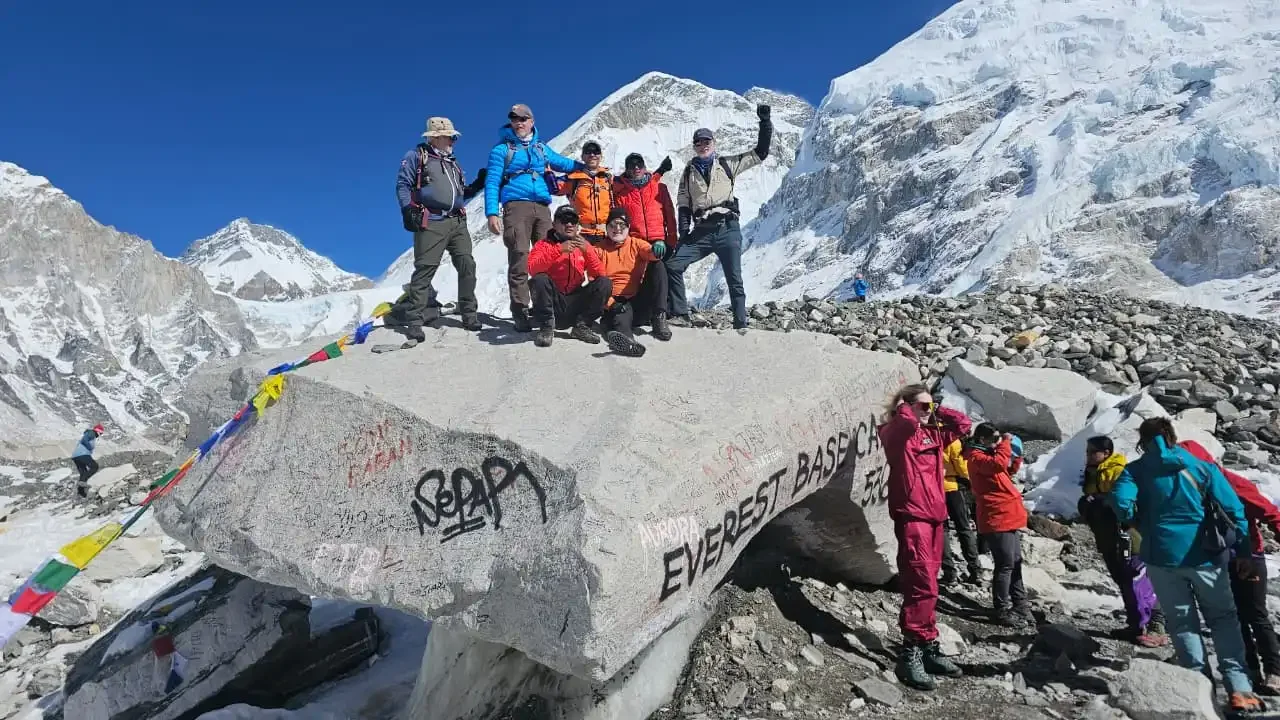
{"time":1783870388931,"blocks":[{"id":"QHS6CV0I49","type":"paragraph","data":{"text":"<a href=\"https:\/\/expeditionhimalaya.com\/package\/everest-base-camp-trek\/\" target=\"_blank\" rel=\"nofollow\">Everest Base Camp <\/a>sits at\n5,364m, and on the day you reach it you will not see the summit of Everest\nitself, the mountain is hidden behind Nuptse from that vantage point. That\nsurprises a lot of first-time trekkers, and it is worth knowing before you go,\nbecause the real reward of this trek is not one single photograph. It is two\nweeks spent walking through the Khumbu, past Sherpa villages, monasteries, and\nglaciers, with genuine high-altitude mountains on every side, Everest included,\njust not always in the frame you expect, and with a living culture along the\ntrail that is as much a part of the experience as the mountains themselves."}},{"id":"JsNMB0qN7Y","type":"paragraph","data":{"text":"This guide covers the trek as we\nactually run it: the real itinerary, the permits you need, what it costs, how\ndifficult it is, the people and traditions you will encounter along the way,\nand what to expect day by day."}},{"id":"4JZmeCgaBX","type":"header","data":{"text":"Trek Overview","level":2}},{"id":"RNmM0YgnEM","type":"table","data":{"withHeadings":false,"stretched":false,"content":[["<b>Duration<\/b>\n ","<b>15 days\n (Kathmandu to Kathmandu), including 2 days in Kathmandu before and after the\n trek<\/b>\n "],["Trek Distance\n ","Approximately\n 130km round trip\n "],["Max Elevation\n ","5,545m (Kala\n Patthar); Everest Base Camp itself sits at 5,364m\n "],["Trekking Grade\n ","Challenging: 5\n to 7 hours of walking most days, steeper climbs, high altitude, with built-in\n acclimatization days\n "],["Start \/ End\n Point\n ","Kathmandu, via\n flight to Lukla (routed through Ramechhap during peak season)\n "],["Accommodation\n ","Teahouses\n (lodges) throughout the trek\n "],["Technical Skill\n Required\n ","None. No\n climbing skills or equipment needed\n "],["Best Season\n ","Autumn\n (September to November) and Spring (March to May)\n "]]}},{"id":"YDGazHZ6DO","type":"image","data":{"url":"https:\/\/media.tripcart.com\/images\/2552\/web_1768983578_948908_2085_85_1600x1200.webp","caption":"Acclimatization Hike to Nakartsang View Point.","alt":"Nakartsang Acclimatization Hike","width":1063,"height":797,"withBorder":false,"withBackground":false,"stretched":false}},{"id":"Do8SawZKmL","type":"header","data":{"text":"Difficulty and Who This Trek Suits","level":2}},{"id":"L49Ccln0iA","type":"paragraph","data":{"text":"The Everest Base Camp trek does\nnot require any technical climbing skill, but it is a genuinely demanding trek,\nnot a casual walk. Most days involve five to seven hours of walking on mountain\ntrails, with meaningful daily elevation gain and, eventually, sustained time\nabove 4,000m and 5,000m. The primary challenge is altitude, not terrain. You do\nnot need to be an athlete, but you should arrive with solid general fitness\nand, ideally, some prior multi-day hiking experience."}},{"id":"fpk0d5ESx3","type":"paragraph","data":{"text":"We recommend a minimum of twelve\nweeks of structured physical preparation for anyone without regular hiking or\ntrekking experience, built around cardio endurance and hill or stair training\nwith a loaded pack, since that is what actually transfers to the trail."}},{"id":"HyqKxbshCm","type":"header","data":{"text":"Permits Required","level":2}},{"id":"DmJSIn9KM7","type":"paragraph","data":{"text":"Two permits are required for the\nEverest Base Camp trek, and both are essential, there is no way around either\none."}},{"id":"N_J6wTMb5_","type":"table","data":{"withHeadings":false,"content":[["<b>Permit<\/b>\n ","<b>Approximate\n Cost (Foreign Nationals) \/ Notes<\/b>\n "],["Sagarmatha\n National Park Entry Permit\n ","Required for\n entry to the national park. Arranged entirely by Expedition Himalaya as part\n of your package, one less thing to plan before you travel\n "],["Khumbu Pasang\n Lhamu Rural Municipality Entry Permit\n ","Local\n municipality permit required for the Khumbu region. Also arranged entirely by\n Expedition Himalaya, so you can focus on the trek, not the paperwork\n "]]}},{"id":"harun6ykvy","type":"paragraph","data":{"text":"A TIMS card is not required for\ntrekking in the Khumbu region specifically, since the two permits above cover\nthe area. Expedition Himalaya arranges both permits as part of every EBC trek\npackage, so you do not need to handle this separately."}},{"id":"URKQRG09dS","type":"image","data":{"url":"https:\/\/media.tripcart.com\/images\/2552\/web_1768983771_681943_9689_85_2600x1950.webp","caption":"","alt":"Phakding","width":1063,"height":797,"withBorder":false,"withBackground":false,"stretched":false}},{"id":"7beoomP2WX","type":"header","data":{"text":"Day-by-Day Itinerary","level":2}},{"id":"vCQF7Kg5zo","type":"paragraph","data":{"text":"This is the itinerary we run for\nour Classic Everest Base Camp Trek, a 15-day package including arrival and\ndeparture days in Kathmandu."}},{"id":"CFcsRr-1Su","type":"paragraph","data":{"text":"<b>Day 1: Arrive in Kathmandu\n(1,337m). <\/b>Airport pickup and transfer to your hotel. Rest of the day free."}},{"id":"E7XCcs3h9S","type":"paragraph","data":{"text":"<b>Day 2: Leisure day in\nKathmandu. <\/b>A flexible day to rest, explore, or sort out last-minute gear\nbefore heading into the mountains."}},{"id":"4Rvd_UADQT","type":"paragraph","data":{"text":"<b>Day 3: Drive to Ramechhap,\nfly to Lukla, trek to Phakding (2,610m). <\/b>A short mountain flight to Lukla,\nfollowed by a gentle trek along the Dudh Koshi River to Phakding, an easy first\nday that helps your body begin adjusting to altitude."}},{"id":"7zjEWQ0rAY","type":"paragraph","data":{"text":"<b>Day 4: Trek to Namche Bazaar\n(3,440m). <\/b>The trail crosses several suspension bridges, including the\nwell-known Hillary Suspension Bridge, before a steady climb into Namche Bazaar,\nthe main trading hub of the Khumbu."}},{"id":"8qduR_DfFd","type":"paragraph","data":{"text":"<b>Day 5: Acclimatization day at\nNamche. <\/b>A hike up to Syangboche and the surrounding viewpoints, with\npossible views of Everest, Lhotse, Ama Dablam, and Thamserku on a clear day,\nbefore returning to Namche to rest. If your visit falls on a Saturday, this is\nalso the day to walk through Namche's centuries-old weekly market."}},{"id":"2i8nzD4gqe","type":"paragraph","data":{"text":"<b>Day 6: Trek to Tengboche\n(3,870m). <\/b>Forested trail with views of Ama Dablam and Everest, descending\nto the river before climbing to Tengboche, home to the region's most important\nmonastery."}},{"id":"SeCYGfFcaj","type":"paragraph","data":{"text":"<b>Day 7: Trek to Dingboche\n(4,360m). <\/b>The trail moves into alpine terrain as trees thin out, passing\nstone-walled fields, with Ama Dablam towering above the village."}},{"id":"jSExxNBT6A","type":"paragraph","data":{"text":"<b>Day 8: Acclimatization day at\nDingboche. <\/b>A short morning hike to Nakartshang viewpoint for altitude\nadjustment, followed by rest."}},{"id":"5kwbYjS7PL","type":"paragraph","data":{"text":"<b>Day 9: Trek to Lobuche\n(4,930m). <\/b>The trail follows the edge of the Khumbu Glacier, passing\nmemorials to climbers connected to Everest's mountaineering history."}},{"id":"gq4-PTwOxO","type":"paragraph","data":{"text":"<b>Day 10: Trek to Gorak Shep\n(5,160m) and hike to Everest Base Camp (5,364m). <\/b>After reaching Gorak Shep,\nthe last settlement before Base Camp, you continue on to Everest Base Camp\nitself, walking across glacial moraine, before returning to Gorak Shep for the\nnight."}},{"id":"lHRqcqP5ac","type":"paragraph","data":{"text":"<b>Day 11: Hike to Kala Patthar\n(5,545m), trek to Pheriche (4,370m). <\/b>An early-morning climb to Kala Patthar\nfor the closest available views of Everest, Nuptse, and the Khumbu Icefall,\nfollowed by a descent to Pheriche."}},{"id":"Odj--gc8SF","type":"paragraph","data":{"text":"<b>Day 12: Trek to Namche Bazaar\n(3,440m). <\/b>Retracing the route downhill through familiar villages, with\nwarmer temperatures returning as you lose elevation."}},{"id":"Zbl-NE0nV1","type":"paragraph","data":{"text":"<b>Day 13: Trek to Lukla\n(2,845m). <\/b>The final trekking day, following the river valley back to where\nthe trek began."}},{"id":"uOCxONqijh","type":"paragraph","data":{"text":"<b>Day 14: Fly Lukla to\nRamechhap, drive to Kathmandu. <\/b>Morning flight followed by a road transfer\nback to the city."}},{"id":"5PLq6Yncag","type":"paragraph","data":{"text":"<b>Day 15: International\ndeparture.<\/b>"}},{"id":"fTeGyE-_8q","type":"header","data":{"text":"Altitude and Acclimatization","level":2}},{"id":"22uH4e8jov","type":"paragraph","data":{"text":"Altitude, not distance or\nterrain, is what makes this trek genuinely demanding. The itinerary above\nincludes two dedicated acclimatization days, at Namche Bazaar (3,440m) and\nDingboche (4,360m), both built around the same principle: hike higher during the\nday, then return to sleep at a lower elevation. This \u201cclimb high, sleep low\u201d\napproach is one of the most effective tools for reducing the risk of altitude\nillness, and it is not optional padding in the schedule, it is a core part of\nwhat makes the trek safe."}},{"id":"3L4a07_VjU","type":"paragraph","data":{"text":"Above 4,000m, mild symptoms like\nheadache, reduced appetite, and disrupted sleep are common and not\nautomatically a cause for alarm. Symptoms that worsen rather than improve, or\nthat include confusion, loss of coordination, or breathlessness at rest, are\nsigns to stop ascending and descend, which is why an experienced guide\nmonitoring the group daily matters as much as the itinerary itself."}},{"id":"bjvbJu6nq1","type":"header","data":{"text":"Best Season","level":2}},{"id":"7ubm0JZMO3","type":"paragraph","data":{"text":"Autumn (September to November)\nand spring (March to May) are the two recommended trekking seasons. Autumn\ngenerally offers the clearest visibility of the year and is the busier of the\ntwo seasons; spring brings milder warming temperatures and rhododendron blooms\nat lower elevations. Both seasons offer generally stable weather, in contrast\nto the monsoon months (June to August), when trails are wet and mountain\nflights are far less reliable, and winter (December to February), when the\nroute is passable but significantly colder."}},{"id":"pkqjmiG0lI","type":"header","data":{"text":"The People of the Khumbu: Sherpa Culture and Daily Life","level":2}},{"id":"wemj1LEZpO","type":"paragraph","data":{"text":"The Everest Base Camp trail\npasses through the Khumbu, home to the Sherpa people, and understanding\nsomething about who they are changes the trek from a walk through scenery into\na walk through a living culture. Sherpa ancestors migrated from the Kham region\nof eastern Tibet, most likely between the fifteenth and sixteenth centuries,\ncrossing high passes with their livestock, religious texts, and clan traditions\nbefore settling in the valleys you will trek through today. The name \u201cSherpa,\u201d\nin fact, comes from the Tibetan words for \u201ceastern people.\u201d"}},{"id":"qLRZNT8pQL","type":"paragraph","data":{"text":"Sherpa religious life is built\non the Nyingma school, the oldest tradition within Tibetan Buddhism, and it\nshapes daily life in the Khumbu far more visibly than in most places you may\nhave trekked before. You will pass mani walls, stone walls carved with the\nBuddhist mantra Om Mani Padme Hum, and the custom is to always pass them on\nyour left, walking clockwise, the same direction the prayer wheels are meant to\nbe spun. Prayer flags strung between houses and across bridges carry mantras\ninto the wind with every gust, and chortens, the whitewashed Buddhist shrines\nyou will see at the entrance to nearly every village, mark the threshold\nbetween the ordinary world and a protected one."}},{"id":"Bu9PCghHZH","type":"paragraph","data":{"text":"Mountains themselves hold\nspiritual weight here, not just physical presence. Khumbi Yul Lha, the peak\nthat rises above Khumjung near Namche, is regarded as the guardian deity of the\nKhumbu region, and Sherpa mountaineers traditionally seek its blessing, along\nwith that of the specific mountain they are climbing, before any serious\nascent. This is the origin of the puja ceremony performed at the start of\nnearly every expedition in Nepal, a Buddhist blessing ritual in which a lama or\nsenior guide requests the mountain's permission before a team begins climbing.\nIf you trek past a Base Camp during expedition season, you may see the incense,\nprayer flags, and small altar of a puja site still standing."}},{"id":"vEy8v178PB","type":"paragraph","data":{"text":"Village life along the trail\nstill runs on patterns older than trekking tourism itself. Namche Bazaar's\nSaturday market, held in the same amphitheater-shaped plaza for centuries, grew\nout of trans-Himalayan trade caravans that once carried salt and wool across\nthe Nangpa La pass from Tibet in exchange for grain from the lower hills. Today\nthe same market sells vegetables, yak cheese, butter, and handicrafts, and\nwalking through it on a Saturday morning is one of the more genuine, unstaged\ncultural experiences on the entire route. Higher up, potato farming, introduced\nto the Khumbu in the nineteenth century, transformed the local economy enough\nthat the surplus it created is credited with helping fund the building of the\nregion's great monasteries, Tengboche among them, in the early twentieth\ncentury."}},{"id":"43iUzVchpt","type":"paragraph","data":{"text":"None of this is separate from\nthe trekking industry, either. Sherpa guides, climbing Sherpas, and lodge\nowners are the backbone of nearly every expedition and trek in this region, and\nthe mountaineering reputation the Sherpa people have earned globally, from the\nfirst ascent of Everest in 1953 with Tenzing Norgay to the countless\nexpeditions since, is built on generations of skill specific to this terrain.\nSpending time talking with your guide or a lodge owner about their family's\nhistory in the mountains is, in our experience, one of the most memorable parts\nof the trek for clients, often more so than any single viewpoint."}},{"id":"939jngasFd","type":"header","data":{"text":"Festivals of the Everest Region and Timing Your Trek Around Mani Rimdu","level":2}},{"id":"ExXGwzgo_c","type":"paragraph","data":{"text":"If your schedule allows some\nflexibility, timing an Everest Base Camp trek around a Sherpa festival adds a\ngenuine layer to the experience that a standard departure does not offer."}},{"id":"482AR7LH64","type":"paragraph","data":{"text":"The most significant of these is\nMani Rimdu, a Buddhist festival rooted in the Nyingma tradition and centered on\nTengboche Monastery, the same monastery your itinerary already passes through\non Day 6. The full ritual cycle runs nineteen days, beginning with private\nmonastic ceremonies, but the public celebration, when the monastery courtyard\nopens to visitors, typically runs for three days toward the end of that cycle.\nThe festival marks the legendary triumph of Buddhism over the region's older\nanimistic beliefs, and its centerpiece is the Cham, a sequence of masked dances\nperformed by monks who have spent days in meditation preparing to embody the\ndeities and protectors they portray on the day. The Dance of the Black Hat\nSorcerer, performed to ritually cleanse the courtyard of negative forces, and\nthe fierce, multicolored masks of the Dharma protectors, meant to represent\ncompassion overcoming ignorance rather than malice, are both genuinely striking\nto witness in person, even without understanding every layer of symbolism\nbehind them."}},{"id":"gXCGCNoUPs","type":"paragraph","data":{"text":"In 2026, the public days of Mani\nRimdu at Tengboche are expected to fall around the fourth week of October,\nthough as with all Tibetan lunar calendar festivals, the exact dates are\nconfirmed closer to the time. If witnessing it matters to you, we recommend\ncontacting us a few months ahead so we can time your departure to have you at\nTengboche on the right days, since this is a straightforward adjustment to the\nstandard itinerary rather than a separate trip."}},{"id":"BBGx9hc1BM","type":"paragraph","data":{"text":"Mani Rimdu is not the only\nfestival worth knowing about. Losar, the Tibetan and Sherpa New Year, falls in\nFebruary or March and is celebrated with some variation across the Khumbu,\nvillages like Namche and Tengboche observe Gyalpo Losar while Thame, Khumjung,\nand Pangboche follow Sonam Losar on a different date within the same lunar\ncycle. Dumji, a monastery-specific festival honoring Guru Rinpoche, is\ncelebrated in several Khumbu villages at different times through the year, most\nvisibly in Namche and Khumjung. These fall outside the standard autumn and\nspring trekking windows more often than Mani Rimdu does, but if your travel\ndates happen to align, it is worth asking us whether a local celebration will\nbe happening in the villages you are passing through."}},{"id":"_6L8DrK_cv","type":"image","data":{"url":"https:\/\/media.tripcart.com\/images\/2552\/web_1768983784_910048_5855_85_2600x1950.webp","caption":"Tengboche Monastery - Everest region","alt":"Tengboche Monastery","width":1063,"height":797,"withBorder":false,"withBackground":false,"stretched":false}},{"id":"bx4xOM7o1T","type":"header","data":{"text":"Cost: What's Included and What Isn't","level":2}},{"id":"VG8gMPYUlo","type":"paragraph","data":{"text":"Our <a href=\"https:\/\/expeditionhimalaya.com\/package\/everest-base-camp-trek\/\" target=\"_blank\" rel=\"nofollow\">Classic Everest Base Camp\nTrek<\/a> starts from USD 1,800 per person for group trekking and USD 2,100 for solo\ntrekkers."}},{"id":"j1y3-z2KVH","type":"paragraph","data":{"text":"<b>What's included: <\/b>airport\npickup and drop-off, 3 nights in a Kathmandu hotel with breakfast, domestic\nflights (Ramechhap to Lukla and return), all permits (Sagarmatha National Park\nand Khumbu Rural Municipality), full board teahouse accommodation during the\ntrek, an English-speaking experienced guide, support staff, a trail medical\nkit, and insurance for Sherpa and support staff."}},{"id":"wDfwHiIbyw","type":"paragraph","data":{"text":"<b>What's not included: <\/b>international\nairfare and Nepal visa fees, personal travel and medical\/evacuation insurance,\nmeals in Kathmandu, personal expenses (laundry, bottled water, charging, bar\nbills), tips for guides and staff, and any extra costs arising from weather\ndelays or itinerary changes."}},{"id":"_4gddBP8bl","type":"header","data":{"text":"Required Gear","level":2}},{"id":"s8WraEQF_Z","type":"paragraph","data":{"text":"You do not need technical\nclimbing equipment for this trek, but proper gear matters more than people\nexpect, especially footwear and insulation. At minimum you will need broken-in\ntrekking boots suited to multi-day use, a warm down jacket, layered clothing\nfor a wide temperature range (15 to 20\u00b0C in the lower valleys down to well\nbelow freezing at night above 4,000m), trekking poles, a sleeping bag rated for\ncold temperatures (even though lodges provide bedding, extra warmth matters at\naltitude), sun protection, and a reliable daypack. We provide a full packing\nlist before departure and can help arrange rental gear in Kathmandu for\nanything you would rather not travel with."}},{"id":"j8cNtBVjf7","type":"header","data":{"text":"Food and Accommodation on the Trail","level":2}},{"id":"LtBF4D5GQd","type":"paragraph","data":{"text":"Accommodation throughout the\ntrek is in teahouses, simple mountain lodges with twin-share rooms. Rooms get\nmore basic as you gain altitude, and hot showers and charging are available at\nmost lodges for an additional cost, though these services become more limited\nabove Dingboche. Meals blend Nepali, Tibetan, and simple Western dishes: dal\nbhat, noodles, soups, potatoes, and eggs are trail staples, along with hot\ndrinks like tea, coffee, and ginger-lemon-honey, which genuinely helps at\naltitude. Drinking water should be boiled, filtered, or treated with\npurification tablets; bottled water is discouraged both for cost and\nenvironmental reasons at altitude."}},{"id":"SW1WYZBnFX","type":"header","data":{"text":"Kala Patthar: Is It Worth the Extra Effort","level":2}},{"id":"x7IKDH0lnG","type":"paragraph","data":{"text":"Kala Patthar (5,545m) is\ntechnically an optional add-on beyond Everest Base Camp itself, but nearly\nevery trekker who reaches Gorak Shep chooses to do it, and for good reason.\nBecause Everest itself is not visible from Base Camp, hidden behind Nuptse, Kala\nPatthar is the point on this entire trek that actually delivers the classic,\nunobstructed view of Everest's summit, along with Nuptse and the Khumbu\nIcefall. The early-morning climb is cold and adds real effort on top of an\nalready demanding day, but if the purpose of your trip includes actually seeing\nEverest's summit up close, this is where that happens, not at Base Camp."}},{"id":"VyX40bbR04","type":"header","data":{"text":"What to Expect Honestly","level":2}},{"id":"9jkmzwcw30","type":"paragraph","data":{"text":"This trek is rewarding, but it\nis not comfortable in the way a resort holiday is comfortable, and it should\nnot be sold as one. Nights above 4,000m are cold even in the recommended\nseasons. Appetite often drops at altitude, which is normal but still unpleasant.\nLong uphill days followed immediately by more altitude gain the next day\naccumulate fatigue, and by day eight or nine most trekkers are tired in a way\nthat good boots and fitness cannot fully prevent, altitude affects everyone,\nregardless of preparation. Flight delays to and from Lukla due to weather are\ncommon enough that we build buffer days into the schedule and recommend against\nbooking tight onward connections. None of this makes the trek not worth doing.\nIt makes it a real trek, not a scenic walk, and going in with accurate\nexpectations makes the experience better, not worse."}},{"id":"E841zQqDhQ","type":"image","data":{"url":"https:\/\/media.tripcart.com\/images\/2552\/web_1768983875_276957_6933_85_1176x698.webp","caption":"","alt":"Everest Base Camp Trek - Lunch Break","width":1063,"height":631,"withBorder":false,"withBackground":false,"stretched":false}},{"id":"pUc6u68VwL","type":"header","data":{"text":"Frequently Asked Questions About the Everest Base Camp Trek","level":2}},{"id":"MEs-bVsiFL","type":"paragraph","data":{"text":"<b>Q: How many days does the\nEverest Base Camp trek take?<\/b>"}},{"id":"Ipmg1NQHPk","type":"paragraph","data":{"text":"A: Our standard itinerary is 15\ndays from Kathmandu to Kathmandu, including 2 days in Kathmandu before the trek\nand 1 day after. The trekking portion itself is around 12 days. Shorter\nitineraries exist but generally compress acclimatization days, which we do not\nrecommend."}},{"id":"TE5gmUFu5P","type":"paragraph","data":{"text":"<b>Q: How difficult is the\nEverest Base Camp trek for a beginner?<\/b>"}},{"id":"IRIBlMhVyF","type":"paragraph","data":{"text":"A: It is rated Challenging: no\ntechnical climbing skill is required, but you should be comfortable walking 5\nto 7 hours a day on mountain trails and be prepared for sustained high\naltitude. Prior multi-day hiking experience helps but is not mandatory if you\ntrain properly beforehand."}},{"id":"LhizZ6mDYQ","type":"paragraph","data":{"text":"<b>Q: Will I be able to see\nMount Everest's summit from Everest Base Camp?<\/b>"}},{"id":"qdE6M61yl_","type":"paragraph","data":{"text":"A: No. Everest's summit is\nhidden behind Nuptse when viewed from Base Camp itself. Kala Patthar (5,545m),\na short additional climb from Gorak Shep, is where you get the clear, classic\nview of Everest's summit."}},{"id":"2cFBacYfr4","type":"paragraph","data":{"text":"<b>Q: What is the best season\nfor the Everest Base Camp trek?<\/b>"}},{"id":"M43Zf84vOk","type":"paragraph","data":{"text":"A: Autumn (September to\nNovember) and spring (March to May), when weather is most stable and visibility\nis best. Autumn is generally the clearer and busier of the two seasons."}},{"id":"EIEvc8GCC1","type":"paragraph","data":{"text":"<b>Q: Can I time my trek to\ncoincide with the Mani Rimdu festival?<\/b>"}},{"id":"ec3nnrWbyo","type":"paragraph","data":{"text":"A: Yes, and we recommend it if\nthe timing interests you. Mani Rimdu's public celebration at Tengboche\nMonastery, which your standard EBC itinerary already passes through, typically\nfalls in the fourth week of October, though exact dates follow the Tibetan\nlunar calendar and are confirmed closer to the year in question. Contact us a\nfew months ahead of an October departure and we can adjust your schedule to\nhave you at Tengboche during the public festival days."}},{"id":"1fXcqpO23H","type":"paragraph","data":{"text":"<b>Q: How do I prepare\nphysically for this trek?<\/b>"}},{"id":"z03iknFIu_","type":"paragraph","data":{"text":"A: A minimum of twelve weeks of\nstructured training focused on cardio endurance and hill or stair walking with\na loaded pack. General gym fitness alone does not fully prepare you for hours\nof sustained uphill walking at altitude."}},{"id":"ET1H-pNOaR","type":"paragraph","data":{"text":"<b>Q: Is altitude sickness a\nserious risk on this trek?<\/b>"}},{"id":"qspRt8ZOLF","type":"paragraph","data":{"text":"A: It is a real risk that the\nitinerary is specifically designed to manage, with two dedicated\nacclimatization days built in. Mild symptoms like headache are common and\nusually manageable; your guide monitors the group daily and will adjust pace or\ndescend if symptoms worsen."}},{"id":"onWILsH8IL","type":"paragraph","data":{"text":"<b>Q: What happens if my flight\nto or from Lukla is delayed?<\/b>"}},{"id":"UtlLTVIn0s","type":"paragraph","data":{"text":"A: Delays due to weather are\ncommon on this route. Our itinerary includes buffer time where possible, and we\nrecommend not booking tight international connections immediately after the\ntrek in case of delays."}},{"id":"DJuHjYnNhE","type":"header","data":{"text":"Related Reading from Expedition Himalaya","level":2}},{"id":"zTjKqSO3Cx","type":"paragraph","data":{"text":"\u2022 \n<a href=\"https:\/\/expeditionhimalaya.com\/island-peak-climbing-guide\/\">Island Peak\nClimbing: A Mountaineer's Guide to Imja Tse<\/a>"}},{"id":"SJiu8_u92J","type":"paragraph","data":{"text":"\u2022 \n<a href=\"https:\/\/expeditionhimalaya.com\/why-autumn-best-season-himalayan-expeditions\/\">Why\nAutumn Is the Best Season for Himalayan Expeditions and Trekking<\/a>"}},{"id":"fRaScyq_8X","type":"paragraph","data":{"text":"\u2022 \n<a href=\"https:\/\/expeditionhimalaya.com\/expedition-and-trekking-gear-guide\/\">Complete\nGear Checklist for Himalayan Expeditions 2026<\/a>"}}],"version":"2.31.0"}
Previous
Common Mistakes First-Time Trekkers Make in Nepal
Next
Manaslu Circuit Trek: The Trails, the Mountains, and the People Who Call This Valley Home