sales@expeditionhimalaya.com
+977 985-1004278
Customize Trip
All Packages
Trekking
Everest Region
Annapurna Region
Langtang Region
Makalu Region
Manaslu Region
Wilderness & Remote Trek
Expeditions
8000ers
7000ers
6000ers
Combo
Tours
Nepal Experiences
Scenic Helicopter Tours
Tibet
Information
Booking Terms and Conditions
Expedition & Trekking Gear Guide
Permit | Garbage
Nepal Travel & Visa Guide (Updated 2026)
Tibet Tour Guide Book
A Dining Guide by Expedition Himalaya
Company
About Expedition Himalaya
Meet the Team
Blog
Testimonials
Legal Documents
Contact Us
Traveler Login
Open main menu
Close menu
All Packages
Trekking
Everest Region
Annapurna Region
Langtang Region
Makalu Region
Manaslu Region
Wilderness & Remote Trek
Expeditions
8000ers
7000ers
6000ers
Combo
Tours
Nepal Experiences
Scenic Helicopter Tours
Tibet
Information
Booking Terms and Conditions
Expedition & Trekking Gear Guide
Permit | Garbage
Nepal Travel & Visa Guide (Updated 2026)
Tibet Tour Guide Book
A Dining Guide by Expedition Himalaya
Company
About Expedition Himalaya
Meet the Team
Blog
Testimonials
Legal Documents
Contact Us
Traveler Login
sales@expeditionhimalaya.com
+977 985-1004278
Customize Trip
All Packages
Trekking
Everest Region
Annapurna Region
Langtang Region
Makalu Region
Manaslu Region
Wilderness & Remote Trek
Expeditions
8000ers
7000ers
6000ers
Combo
Tours
Nepal Experiences
Scenic Helicopter Tours
Tibet
Information
Booking Terms and Conditions
Expedition & Trekking Gear Guide
Permit | Garbage
Nepal Travel & Visa Guide (Updated 2026)
Tibet Tour Guide Book
A Dining Guide by Expedition Himalaya
Company
About Expedition Himalaya
Meet the Team
Blog
Testimonials
Legal Documents
Contact Us
Traveler Login
Open main menu
Close menu
All Packages
Trekking
Everest Region
Annapurna Region
Langtang Region
Makalu Region
Manaslu Region
Wilderness & Remote Trek
Expeditions
8000ers
7000ers
6000ers
Combo
Tours
Nepal Experiences
Scenic Helicopter Tours
Tibet
Information
Booking Terms and Conditions
Expedition & Trekking Gear Guide
Permit | Garbage
Nepal Travel & Visa Guide (Updated 2026)
Tibet Tour Guide Book
A Dining Guide by Expedition Himalaya
Company
About Expedition Himalaya
Meet the Team
Blog
Testimonials
Legal Documents
Contact Us
Traveler Login
sales@expeditionhimalaya.com
+977 985-1004278
Customize Trip
Common Mistakes First-Time Trekkers Make in Nepal
Written by:
Niren Maharjan
Published On Jul 12, 2026
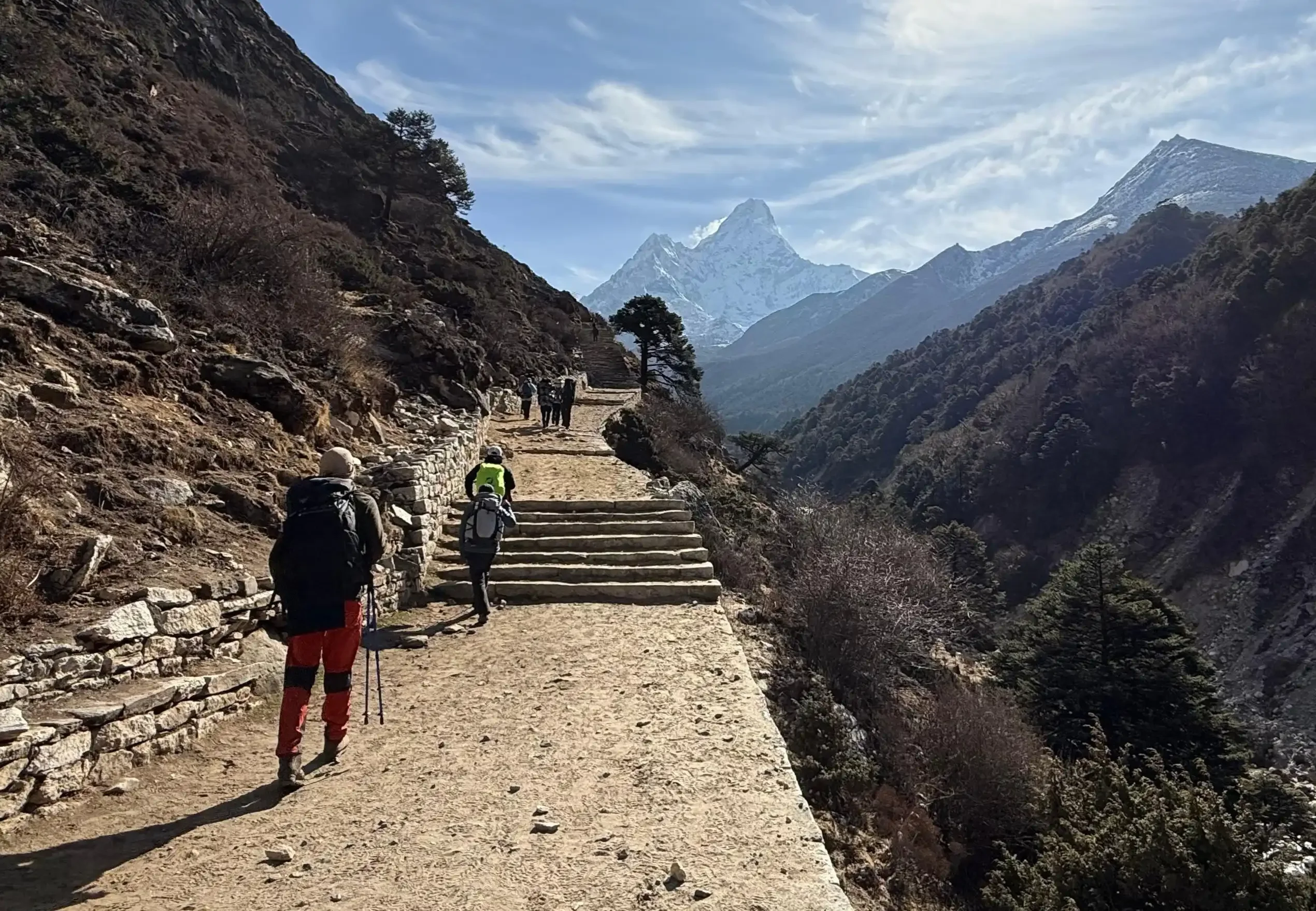
{"time":1783868809352,"blocks":[{"id":"e7iDzJDquI","type":"paragraph","data":{"text":"After watching thousands of\nfirst-time trekkers pass through our hands over the years, the same handful of\nmistakes show up again and again, and almost none of them are about fitness.\nMost first-time trekkers who struggle on the trail are reasonably fit. What\ntrips them up is usually a decision made weeks before departure or in the first\ntwo days on the trail, not a lack of physical capability. This is a rundown of\nthe mistakes we see most often, and what to do instead."}},{"id":"1f8rKSSAf3","type":"header","data":{"text":"Going Too Fast, Too Early","level":2}},{"id":"7TJvC5VBfI","type":"paragraph","data":{"text":"This is the single biggest\nmistake, and it is almost always well-intentioned. Trekkers arrive fit,\nmotivated, and eager, and on the first two or three days, when the altitude is\nstill relatively low and the trail feels manageable, they walk faster than their\nguide recommends. The problem is that altitude gain compounds. Moving fast on\nday two does not cause visible problems on day two, it causes problems on day\nfive or six, once you are sleeping above 4,000m and your body has had less time\nthan it needed to adjust. A guide who keeps telling you to slow down in the\nfirst few days is not being overly cautious, they are protecting a margin you\ncannot see yet. Pace yourself as though the trek is longer than it is, because\nthe payoff shows up later, not immediately."}},{"id":"24aI9LK1ge","type":"header","data":{"text":"Underestimating Acclimatization Days","level":2}},{"id":"XnP5kkDSz9","type":"paragraph","data":{"text":"Closely related: some first-time\ntrekkers see a rest day on the itinerary and consider skipping the associated\nshort hike, treating it purely as a day off. Acclimatization days are not idle\ndays. The \u201cclimb high, sleep low\u201d hikes built into a proper itinerary are doing\nreal physiological work, and skipping them to rest in bed instead removes a\nmeaningful part of what makes the schedule safe. If you booked an itinerary\nwith two acclimatization days, use both of them as designed."}},{"id":"XT_pv7j7Be","type":"header","data":{"text":"Getting Drinking Water Wrong","level":2}},{"id":"HWc5yUztRc","type":"paragraph","data":{"text":"Water is one of the most\nunderestimated parts of trekking preparation, and mistakes here take two\ndifferent forms. The first is not drinking enough. Proper hydration, generally\nthree to four liters a day at altitude, genuinely supports acclimatization, and\ndehydration on its own can mimic or worsen symptoms that look like altitude\nillness, which makes it harder for you and your guide to tell what's actually\ngoing on. The second mistake is treating water carelessly. Untreated tap or\ntap-adjacent water in teahouses can carry giardia and other parasites that\ncause serious gastrointestinal illness, exactly the kind of thing that ends a\ntrek early. Boiled water, a quality filter or purification tablets, or a UV\nsteripen are all reasonable methods, but pick one, carry a backup, and use it\nevery time, not just when it's convenient. Bottled water is widely discouraged\non the trail, both because plastic waste at altitude is a genuine environmental\nproblem in the Himalayas and because its cost climbs sharply the higher you go,\noften two or three times the price by the time you reach the Final ."}},{"id":"l7P7j2Ph21","type":"header","data":{"text":"Alcohol, Sleeping Pills, and Self-Medicating at Altitude","level":2}},{"id":"OOVyOXw0Qg","type":"paragraph","data":{"text":"This is a safety mistake more\nthan a comfort one. Alcohol and sedative sleeping pills both suppress your\nbody's normal breathing response, the same mechanism your body relies on to\nhelp it acclimatize, and both can mask or mimic the early symptoms of altitude\nillness, making it genuinely harder for you or your guide to recognize a real\nproblem developing. Wilderness medicine guidelines are specific about this:\navoid alcohol and sedatives, especially in the first two days at any new\naltitude. If you're considering Diamox (acetazolamide) to help with\nacclimatization, discuss the dosage with a doctor before you travel rather than\nexperimenting with it for the first time on the trail, and remember it requires\nyou to drink even more water than usual while taking it."}},{"id":"OZZW5bvI3D","type":"header","data":{"text":"Running Out of Cash","level":2}},{"id":"wV0KTgIYKS","type":"paragraph","data":{"text":"Card payments and reliable ATMs\nlargely disappear once you're a few days into the trail. Namche Bazaar has\nATMs, but they are known for running out of cash or having technical issues\nduring peak season, and nothing beyond Namche should be counted on at all.\nNearly every teahouse, shop, and charging station from Namche onward operates\non cash only, in Nepali rupees, and change for large notes can be hard to come\nby in smaller villages. We recommend exchanging money in Kathmandu before you\nfly out and carrying more than you think you'll need, including a buffer for\nhot showers, wifi, charging, snacks, and tips, since running short with no way\nto withdraw more is a genuinely stressful problem to have at 4,900m."}},{"id":"EYpeZ5i4_q","type":"header","data":{"text":"Ignoring Basic Hygiene","level":2}},{"id":"aqdBdgH4GV","type":"paragraph","data":{"text":"Stomach illness and the\npersistent, dry hacking cough locally known as \u201cKhumbu cough\u201d are two of the\nmost common reasons a trek gets harder than it needs to be, and both are more\npreventable than people expect. Hand sanitizer before meals, being cautious\nwith raw or unwashed food at higher elevations, and keeping a scarf or buff\nover your mouth and nose on dusty, high-traffic sections of trail all\nmeaningfully reduce your odds of either one. It's a small habit that's easy to\nskip when you're tired, and exactly the kind of thing that's much easier to\nprevent than to recover from mid-trek."}},{"id":"O1A1JrIBAi","type":"header","data":{"text":"Ignoring Mild Symptoms Because They Don't Feel Serious","level":2}},{"id":"qYIBmQ2KbS","type":"paragraph","data":{"text":"A mild headache or a slightly\nreduced appetite above 3,500m is common and, on its own, not usually dangerous.\nThe mistake is not having the symptom, it is downplaying it to your guide\nbecause it feels minor, or because you do not want to be the one who slows the\ngroup down. Altitude illness typically progresses gradually before it becomes\ndangerous, and an experienced guide who hears about a mild symptom early can\nadjust your pace or add a rest day before it becomes a real problem. Trekkers\nwho stay quiet about early symptoms out of pride or a desire not to be a bother\nare the ones most likely to have a genuinely bad day later in the trek."}},{"id":"gSHpnNwi-D","type":"header","data":{"text":"Choosing an Operator Based on Price Alone","level":2}},{"id":"UY7rduNXfJ","type":"paragraph","data":{"text":"Trekking packages in Nepal vary\nin price for real reasons, not just markup. A significantly cheaper package\noften means a lower guide-to-client ratio, less experienced staff, thinner\ncontingency planning, or an itinerary compressed to save on teahouse nights,\nexactly the acclimatization days that matter most. First-time trekkers,\nunfamiliar with what should be included, sometimes book on price without\nunderstanding what they are trading away. Ask direct questions before booking:\nhow many acclimatization days are built in, what is the guide-to-client ratio,\nwhat happens if the itinerary needs to change for weather. A good operator\nanswers these clearly rather than deflecting."}},{"id":"-3UaurSxKy","type":"header","data":{"text":"Not Training With a Loaded Pack","level":2}},{"id":"N_RmlirhD7","type":"paragraph","data":{"text":"General fitness is not the same\nas trekking fitness. We consistently see clients who run or cycle regularly but\nnever once trained on a hill with a loaded daypack, and they are surprised by\nhow different that feels on day four of an actual trek. The muscular endurance\nneeded for hours of sustained uphill and downhill walking with weight is\nspecific, and it needs specific preparation, not just general cardio."}},{"id":"pvWf3Ttt7H","type":"header","data":{"text":"Underestimating the Descent","level":2}},{"id":"_ZPKxVkwEi","type":"paragraph","data":{"text":"Trekkers train and mentally\nprepare for the climb up, and then are caught off guard by how much harder the\ndescent is on tired legs and joints. Altitude gain gets most of the attention,\nbut the days heading back down, often on tired knees after a demanding summit\nday or high point, are where fatigue-related missteps and injuries are more\nlikely to happen. Pace the descent with the same care as the ascent, and use\ntrekking poles, they matter more on the way down than most people expect."}},{"id":"YcKU1WL4Tp","type":"header","data":{"text":"Photographing People and Sacred Sites Without Asking","level":2}},{"id":"Ngnqfqll8O","type":"paragraph","data":{"text":"This one is more about respect\nthan safety, but it matters. Monasteries, mani walls, chortens, and prayer\nwheels are active religious sites, not photo backdrops, and the etiquette of\npassing them on the left and walking clockwise is worth learning before you go,\nnot figuring out on the spot. The same goes for photographing local people, a\nquick, friendly ask first goes a long way, and is almost always met warmly when\nyou take the time to do it."}},{"id":"nqY1jQDST_","type":"header","data":{"text":"Not Budgeting for the Extras","level":2}},{"id":"MzdUn601Rs","type":"paragraph","data":{"text":"Package pricing typically\nexcludes things like international insurance, tips, bottled water and charging\nat higher teahouses, and personal expenses in Kathmandu. First-time trekkers\nsometimes budget only for the headline package price and are caught short on\nthe trail. Ask your operator for a realistic estimate of daily extras before\nyou go, so there are no surprises when you're two weeks in."}},{"id":"1fUgxWuFrm","type":"header","data":{"text":"Skipping Proper Travel Insurance","level":2}},{"id":"ddm24cvV69","type":"paragraph","data":{"text":"This deserves its own mention\nbecause the consequences are serious. Standard travel insurance frequently does\nnot cover high-altitude trekking or emergency helicopter evacuation, and\nfirst-time trekkers sometimes discover this only after they need it. A rescue\nfrom above 5,000m can cost many thousands of dollars without the right\ncoverage. Confirm specifically that your policy covers trekking at your planned\naltitude and includes helicopter evacuation before you leave home, not once\nyou're on the trail."}},{"id":"Q8igcBHFy9","type":"header","data":{"text":"Frequently Asked Questions","level":2}},{"id":"cZDxnCpD3O","type":"paragraph","data":{"text":"<b>Q: What is the single most\ncommon mistake first-time trekkers make?<\/b>"}},{"id":"YX2c7B_Rtz","type":"paragraph","data":{"text":"A: Moving too fast in the first\nfew days of the trek, before the effects of altitude gain have caught up with\nthem. It rarely causes problems immediately, which is exactly why it is so easy\nto get wrong."}},{"id":"P9cbUi-8VX","type":"paragraph","data":{"text":"<b>Q: How much water should I\nactually be drinking on a trek?<\/b>"}},{"id":"L2CA8aW1T4","type":"paragraph","data":{"text":"A: Generally three to four\nliters a day at altitude. Dehydration can mimic or worsen symptoms that look\nlike altitude illness, which makes proper hydration a genuine part of staying\nsafe, not just staying comfortable."}},{"id":"bx2YRF-uVw","type":"paragraph","data":{"text":"<b>Q: Is it safe to drink tap or\ntea house water in Nepal?<\/b>"}},{"id":"29DkZZnJQx","type":"paragraph","data":{"text":"A: Not without treating it\nfirst. Boiling, a quality filter, purification tablets, or a UV steripen are\nall reasonable options. Untreated water can carry giardia and other parasites\nthat cause serious gastrointestinal illness on the trail."}},{"id":"R5Dhin4DGT","type":"paragraph","data":{"text":"<b>Q: Can I drink alcohol during\nmy trek?<\/b>"}},{"id":"Pc1j4haeZg","type":"paragraph","data":{"text":"A: We recommend avoiding it\nentirely during the first two days at any new altitude, and going easy on it\nthroughout. Alcohol suppresses the breathing response your body relies on to\nacclimatize and can mask real symptoms of altitude illness."}},{"id":"6qyVA3BMKu","type":"paragraph","data":{"text":"<b>Q: Will I be able to use my\ncard on the trail?<\/b>"}},{"id":"JFsfljKwsl","type":"paragraph","data":{"text":"A: Rarely beyond Namche Bazaar,\nand even Namche's ATMs are unreliable during peak season. Plan to carry enough\nNepali rupees in cash for your entire trek, exchanged in Kathmandu before you\ndepart."}},{"id":"-yj-TEtc32","type":"paragraph","data":{"text":"<b>Q: How do I know if a symptom\nis normal or something to worry about?<\/b>"}},{"id":"E9bH8yoXAC","type":"paragraph","data":{"text":"A: Mild headache, slightly\nreduced appetite, and disrupted sleep are common above 3,500m and usually\nmanageable. Symptoms that worsen rather than improve, or that include\nconfusion, loss of coordination, or breathlessness at rest, should be reported\nto your guide immediately and mean it's time to stop ascending."}},{"id":"2CqVgDBLO0","type":"paragraph","data":{"text":"<b>Q: Is a cheaper trekking\npackage a genuine mistake, or just a different option?<\/b>"}},{"id":"wAELiRccXi","type":"paragraph","data":{"text":"A: It depends what's been cut to\nreach that price. A lower cost that comes from a compressed itinerary with\nfewer acclimatization days, or a poor guide-to-client ratio, is a real risk.\nAsk specifically what's included before assuming a lower price is simply a\nbetter deal."}},{"id":"_9EvR1QqDb","type":"paragraph","data":{"text":"<b>Q: Does travel insurance\nreally matter that much for trekking?<\/b>"}},{"id":"E_q50LwFbN","type":"paragraph","data":{"text":"A: Yes. Confirm your policy\nspecifically covers trekking at your planned altitude and includes helicopter\nevacuation. Many standard policies exclude high-altitude trekking by default,\nand this is not something you want to discover after an emergency."}},{"id":"0y4ZtMyrhO","type":"header","data":{"text":"Related Reading from Expedition Himalaya","level":2}},{"id":"CPQfyCe7_S","type":"paragraph","data":{"text":"\u2022 <a href=\"https:\/\/expeditionhimalaya.com\/good-gear-vs-great-gear\/\" target=\"_blank\" rel=\"nofollow\">Good Gear vs. Great Gear: The 5 Gears That Actually Matter in the Himalayas<\/a>"}},{"id":"yJIkinAzvg","type":"paragraph","data":{"text":"\u2022 <a href=\"https:\/\/expeditionhimalaya.com\/expedition-and-trekking-gear-guide\/\">Complete\nGear Checklist for Himalayan Expeditions 2026<\/a>"}}],"version":"2.31.0"}
Previous
Why Autumn Is the Best Season for Himalayan Expeditions and Trekking
Next
Everest Base Camp Trek: The Complete Guide